
How Matka Result Pages Are Structured Online: A Guide
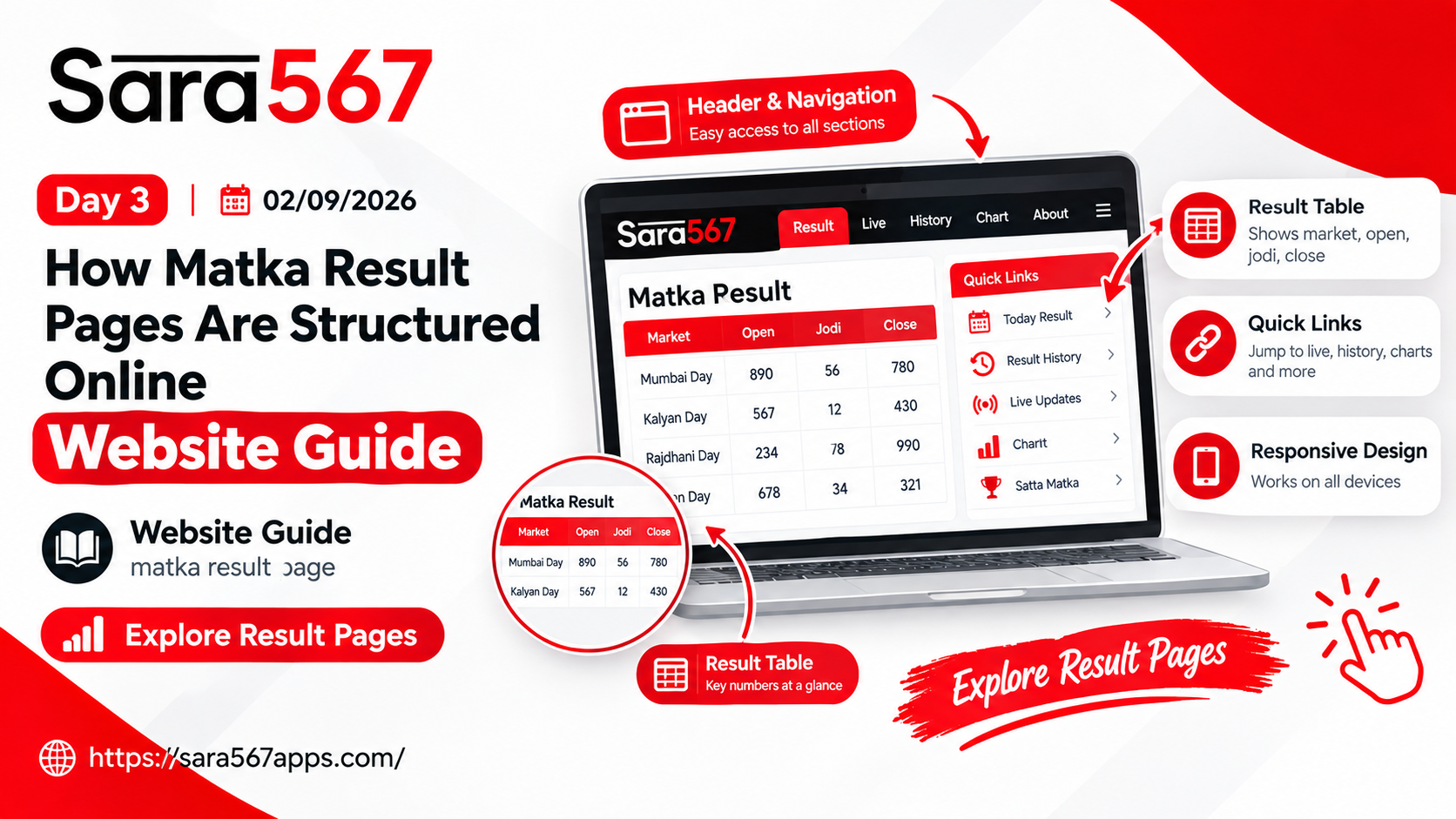
The online page for results is a document on the web that provides information that is designed to show, arrange and store public outcome announcements. They serve as information sources where visitors can review published data and time-tables and search for historical data on certain categories or segments of markets.
Instead of presenting data in an unorganized, raw feed, websites make use of structures like cards, tables, or grid systems -- to make massive amounts of information easy to understand and navigate.
Common Sections of a Result Page
The design aesthetics can differ between platforms, the vast majority of informational pages have a few basic components:
- Title of the Page and Market: Located at the top, this denotes the product, market or the board that is being looked at.
- Date and Schedule Headers: Shows the day of the week and time window that is relevant to the data shown.
- Primary Results Area: The largest area, typically highlighted in large or bold fonts that displays the latest released statistics or the current state of.
- Update Timestamp: A precise date indicator that shows precisely what date the page was last updated on the platform.
- Results History & Archives: An organized table or list that is placed below or next to the main panel. It is used to store the records of earlier sessions, days or even weeks.
- Category Charts: Specially designed grid tables or visual boards that compile long-term records of historical data for users to review.
- Navigating Links & Menus: Controls that permit users to navigate between markets, date pages, or archives.
How Result Information Is Usually Organized
Websites manage complex data through specific structural layouts that enhance scanability
1. Card-Based Layouts
On mobile-friendly sites, card layouts organize information relevant to one market in the form of a rectangular box. The cards typically include the name of the market, its the scheduled time, most recent updates, as well as an option to look back through information.
2. Tabular Layouts
Tables are commonly used to create historic archives as well as charts. They arrange data in a systematic manner into rows (representing sessions or days) as well as columns (representing certain intervals or types) that allow people to look through large quantities of historical information in an organized manner.
3. Grid Systems
A grid places multiple market panels side-by-side on desktop displays. Users can view the entire range of types of information on one display without having to switch pages constantly.
Understanding Dates and Timings
A precise interpretation of information relies on the verification of time markers. Results pages have three distinct markers for time:
- Calendar Date: Denotes the exact date (e.g. 02/09/2026) for the day to which the result corresponds.
- Session Timing: Displays the planned opening and closing time for the particular market release.
- Update Timestamp: Displays the precise time at which the site made or published the content (e.g. The update was published at 03:45 pm IST).
Make sure the date on your calendar is in line with the search criteria you have set. Relying on numbers without checking the date tag is just one of the easiest ways of interpreting data published incorrectly.
Proportion of Results Page Vs Result History
It is essential to differentiate between a result display that is active as opposed to a archive that is archival:
- The Active Results Section focuses solely on the most current release or the current status. It is constantly updated as the latest information is made accessible.
- The Result History Section is a permanently-built, static archive that is designed exclusively for the purpose of record keeping. When data is entered into the history archive, it does not change and only serves as a point of reference for events that occurred in the past.
How to Read a Result Page Step by Step
To verify the accuracy of data in any of the platforms to review information accurately, you must follow this easy procedure step-by-step:
- Find the Title: Make sure that the category heading or market is in line with the particular information you're seeking.
- Check the calendar Date: Check the date label to verify that you have reviewed the correct documents for the correct date.
- Examine the official time stamp: Check for timing markers to determine what session or slot that record is from.
- Find the primary result area: Locate the primary display panel and view the information that has been published.
- Verify: the timestamp and confirm that the date was when the page last refreshed in order to confirm that you're not seeing the cached or outdated data.
- Differentiate History from Updates: Make sure you're reading the primary status screen not an archived row beneath it.
Common Mistakes Beginners Make
- Incorrectly reading the date header: The first step is to scan the numbers without noticing date tags frequently results in users assuming the records from years ago for those of today.
- Confusion of Archived Rows and Current Status: The tables from the past usually appear on the same web page as updates for the present time; mistakenly assuming an archived row as a current update is an incredibly common mistake.
- Unintentionally ignoring Web Page Caching: Some browsers present cached versions of a page. Inability to refresh the web page may hide recent changes.
- In the event that all websites use the same layout: The different platforms employ distinct labels as well as layouts and terms. The assumption that all websites operate the same may result in navigation mistakes.
Why Website Structure Can Vary
A single web standard determines the way that result portals display the data. A platform could place historical tables under the live panel, and others host archives under an entirely separate URL.
Layout variations depend on developer selections, optimization of devices (mobile and desktop. desktop) as well as user interface design. Understanding the fundamental foundational building blocks like headings tables, dates, and timestamps helps you navigate through any results portal with confidence regardless of its style.
Summary of Common Result Page Elements
| Page Element | What It Usually Shows | Why It Matters |
|---|---|---|
| Market / Page Name | The page's ID is the particular the specific category | Aids users to confirm that they're in the right section. |
| Date Header | It indicates the day of the week that falls on it. | Eliminates confusion caused by obsolete or historical information |
| Session Timing | It displays the official schedule, or window | Gives important time context to the data shown |
| Result Section | The main information that has been published is displayed. | The primary focal point of the page |
| Result History | The display shows rows with structured columns of earlier records | This is useful to review data from the past as well as archived entries |
| Update Timestamp | The time stamp indicates when the system was modified. | It helps users determine the quality of information as well as accuracy |
Final Thoughts
Knowing how result pages online structure makes finding the information you need easy and trustworthy. If you follow a systematic approach, such as checking the headings of pages, confirming time stamps and calendar dates and separating active tables from those that are archived--you can browse portals such as ShreeMatka.app in a clear and precise manner.
Frequently Asked Questions (FAQs)
1. What's a matka result page?
A matka result webpage is a web-based informational page that is designed to arrange, display as well as archive publically released information about results as well as historical records of various categories and markets.
2. What kind of information is typically located on a search page?
Common elements are the categories title, the calendar date and scheduled times, the current entry results, updated time stamps, archived historical data and links to navigation.
3. What is the best way to determine the exact date for a test result?
Check for headers with dates just above or next to the panel that displays results. Make sure to verify both tags for the day and month before examining the displayed numbers.
4. What is the significance of timestamps on results pages?
Timestamps indicate the precise date the page was last modified. They allow you to know if you're viewing current information or static cached data.
5. What's the difference between a result page and the history of results?
A page of results displays all market data, as well as the most recent information and updates. The history of results refers to the archived and static record of results from the past that have been kept as a reference.