How to Spot Lookalike Domains in Shared Links
How to Spot Lookalike Domains in Shared Links
When following popular daily markets like Kalyan, Madhur Morning, or Milan Day, links circulate constantly across Telegram groups, WhatsApp chats, forum threads, and social media feeds. Often, these messages promise instant scoreboards, exclusive panel charts, or archived tables.
Because users naturally trust recognized brand names, unscrupulous third parties frequently deploy lookalike domains—also known as typosquatting or cybersquatting. These deceptive addresses are engineered to resemble established, authentic platforms like Sara 567 at a casual glance.
Landing on a lookalike domain can expose you to inaccurate or delayed numbers, intrusive adware networks, or credential-harvesting phishing forms. Learning how to read a web address anatomically and spot lookalike tactics protects your device and guarantees you receive genuine market records.
The Anatomy of a URL: Where the Real Host Lives
To spot a lookalike domain, you must understand how internet domain names are structured from left to right. A common misunderstanding among web visitors is believing that whatever word appears first in a link determines who owns the website.
In reality, the Domain Name System (DNS) evaluates domain hierarchy in reverse order—from right to left:
┌────────────────────────────────────────────────────────────────────────┐
│                        URL HIERARCHY ANATOMY                           │
├────────────────────────────────────────────────────────────────────────┤
│ https://  subdomain.  SECOND-LEVEL-DOMAIN  .TOP-LEVEL-DOMAIN  /path    │
│ ───────   ──────────  ───────────────────  ─────────────────  ─────    │
│ Protocol  Prefix      ROOT NAME (WHO OWNS) TLD (.com, .org)   Folder   │
└────────────────────────────────────────────────────────────────────────┘
The registered domain is strictly defined as the label immediately preceding the Top-Level Domain (TLD) before the first single forward slash (/). Everything to the left of that is merely a subdomain chosen by whoever controls that registered root.
Four Deceptive Techniques Used by Lookalike Domains
Attackers and copycat operators employ four primary tricks to fool human eyes:
1. The Subdomain Masking Trick
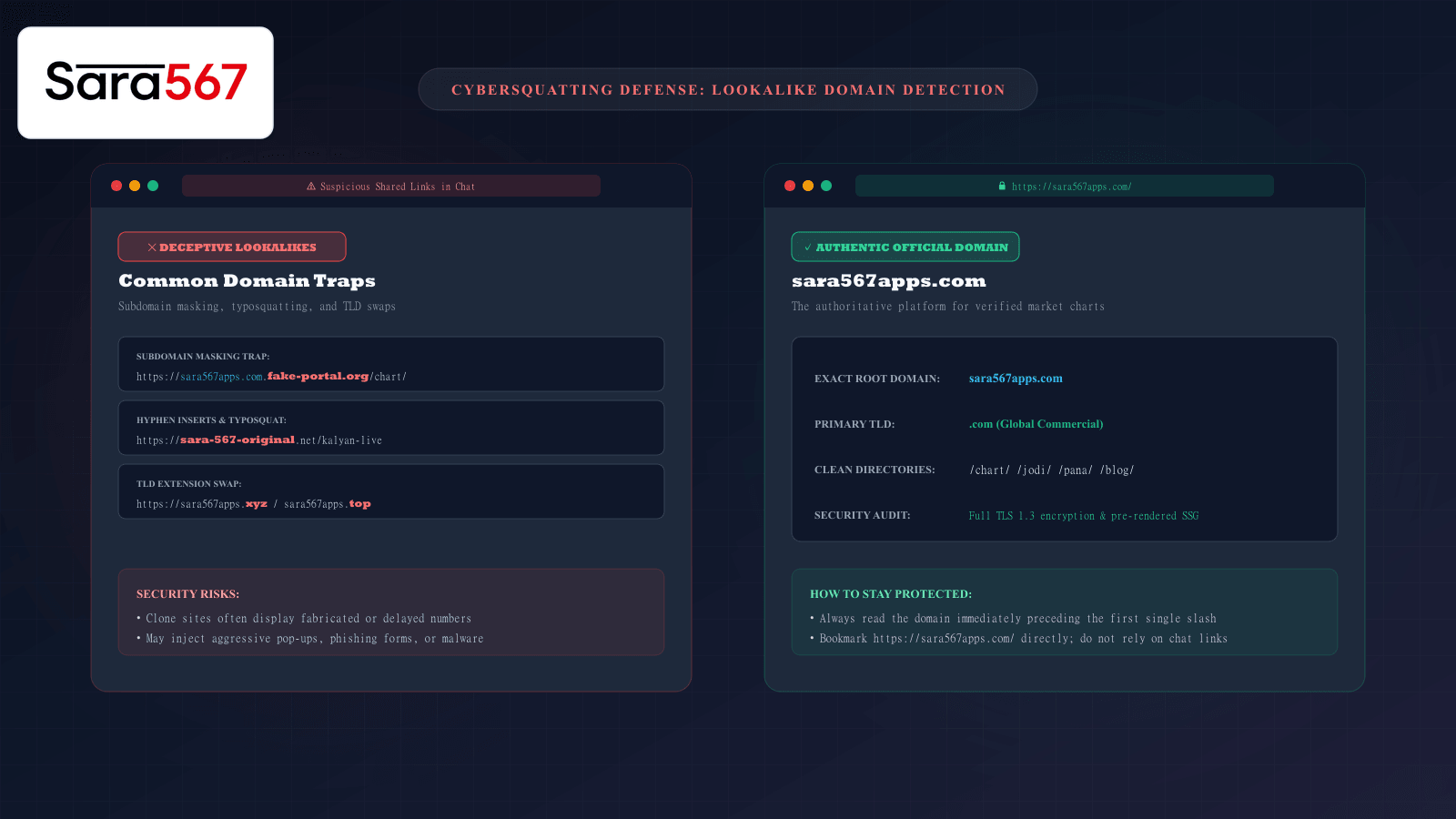
This is the most sophisticated visual deception. The operator registers an unrelated domain (e.g., fraudulent-tracker.net) and creates a subdomain named sara567apps.com:
https://sara567apps.com.fraudulent-tracker.net/chart/
        ▲             ▲ ▲                    ▲
        └─ SUBDOMAIN ─┘ └──── REAL ROOT ─────┘
When a user skims the address quickly on a smartphone where the address bar truncates long URLs, they see "sara567apps.com" and assume they are on the official site, unaware that the actual server is hosted by fraudulent-tracker.net.
2. Hyphen Insertion & Modifier Words
Another common tactic is adding hyphens, prefixes, or suffix words to the authentic brand name:
sara-567apps.com(inserted hyphen)sara567original.com(added suffix)sara567-live.net(added keyword)
Authentic organizations maintain a single canonical brand identity. While a platform may own secondary defensive registrations to protect its trademark, authoritative data is published exclusively on the primary home address: sara567apps.com.
3. Top-Level Domain (TLD) Swapping
If a legitimate organization operates on .com, copycats often purchase the identical name on inexpensive, loosely regulated generic TLDs:
sara567apps.xyzsara567apps.topsara567apps.cc
Because the left-hand text matches character-for-character, hurried visitors overlook the unfamiliar extension at the end.
4. Internationalized Domain Name (IDN) Homograph Attacks
In an IDN homograph attack, the registrant registers a domain using non-Latin Unicode characters (such as Cyrillic or Greek) that appear identical to standard Latin letters. For example, the Cyrillic letter а (U+0430) looks indistinguishable on screen from the Latin letter a (U+0061).
When a browser processes an internationalized domain, it converts it to Punycode, beginning with xn--. If you ever see xn-- in your browser address bar when visiting what you thought was a standard English website, you are viewing an internationalized lookalike!
Checklist: How to Verify Any Shared Link in 5 Seconds
Before clicking or relying on data from a shared link, apply this quick 5-second verification protocol:
┌────────────────────────────────────────────────────────────────────────┐
│                   5-SECOND LINK VERIFICATION PROTOCOL                  │
├────────────────────────────────────────────────────────────────────────┤
│ 1. FIND THE FIRST SINGLE SLASH (/): Ignore everything after the first  │
│    single slash for now. Focus only on what lies between "https://"    │
│    and the first single "/".                                           │
│                                                                        │
│ 2. READ BACKWARDS FROM THE DOT: Find the TLD (.com). The word          │
│    immediately to its left is the true owner. If it does not read      │
│    "sara567apps", you are NOT on the official Sara 567 site.           │
│                                                                        │
│ 3. BEWARE OF HYPHENATED VARIATIONS: Confirm there are no random        │
│    hyphens (sara-567) or modifier words tacked onto the name.          │
│                                                                        │
│ 4. CHECK THE PROTOCOL: Verify the link uses https:// with an active    │
│    valid security lock.                                                │
│                                                                        │
│ 5. WHEN IN DOUBT, TYPE IT DIRECTLY: Never rely on suspicious shortlinks│
│    or shared chat pastes. Type sara567apps.com directly into your      │
│    browser to ensure you reach the genuine source.                     │
└────────────────────────────────────────────────────────────────────────┘
Lookalike Domain Detection Matrix
| Shared URL Snippet | Structure Analysis | Authenticity Verdict | Why It Fails |
|---|---|---|---|
https://sara567apps.com/chart/kalyan/ | Exact root sara567apps.com | ✓ AUTHENTIC | Matches official canonical portal |
https://sara567apps.com.mirror-site.org/ | Subdomain masking | ✕ FAKE | Owned by mirror-site.org |
https://sara-567apps.com/ | Hyphen insertion | ✕ LOOKALIKE | Unofficial clone registration |
https://sara567apps.xyz/ | TLD swap | ✕ UNVERIFIED | Unofficial low-reputation TLD |
https://sаra567apps.com/ (Punycode xn--...) | Homograph Cyrillic а | ✕ MALICIOUS | Punycode character spoofing |
Summary
The internet relies on precise spelling, but human eyes tend to read words as whole shapes. Scammers and unverified clone portals exploit this tendency through lookalike domains, subdomain masking, and TLD substitutions. By learning to identify the true root domain in your address bar and navigating directly to verified sources like Sara 567, you can protect your privacy and ensure that the market records you reference are 100% authentic.
Explore Corresponding Market Charts & Verification Tools
Verify real-time numbers, track open/close records, and analyze weekly trends on our informational dashboard.