
Matka Historical Data: How to Read Trends Responsibly
Matka Historical Data: How to Read Trends Responsibly
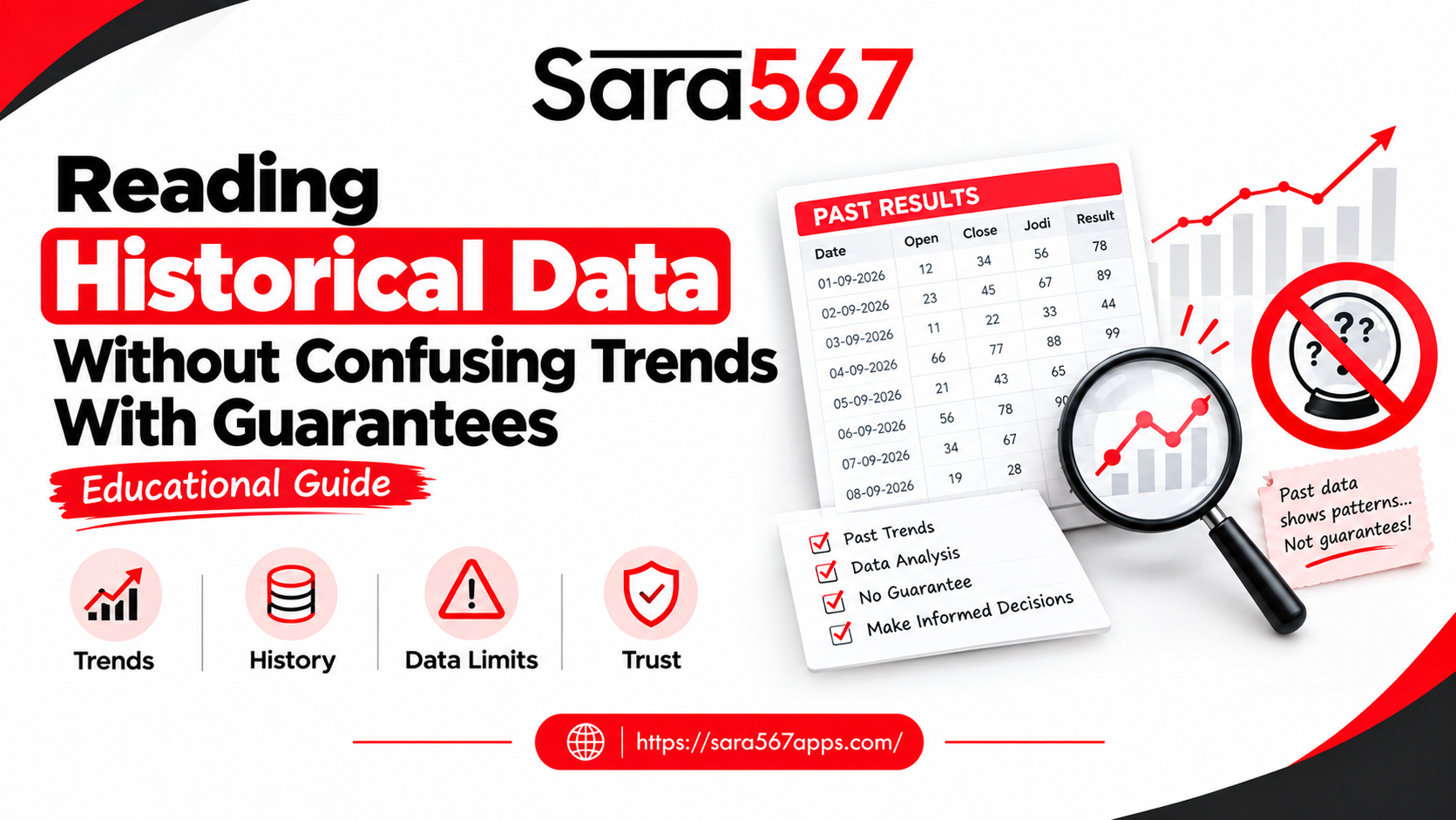
Reading Historical Data Without Confusing Trends With Guarantees
When exploring online archives, databases, or result logs, it is human nature to gravitate towards historical entries first. Perusing old records, numbers, and patterns helps us gain context, organize information, and identify how certain records, results, or digits tend to resurface at regular intervals.
However, one common pitfall that comes with analyzing past logs is the misconception that spotting a pattern means predicting the future. Recognizing this nuance is critically important when reviewing matka historical data, as these records make no guarantees or claims about future results. Understanding how to read historical records while keeping objective distance from assumptions makes data analysis safer and more transparent.
What Is Matka Historical Data
At its core, historical data is an organized repository of finished or closed events. In the case of historical results, you are reviewing a body of work that represents past entries, charts, or logs that have been saved for documentation and archival purposes.
Generally, historical records involve specific subsets of information, such as:
- Specific Dates or Timestamps: Markers that identify when a specific log was made.
- Past Results: Any numbers, digits, or values that were recorded for a specific interval.
- Organized Tables or Charts: Structured records that arrange past digits, numbers, or results in chronological order.
- Categorization: Labels or markers that separate results according to market segments, where applicable.
The primary function of matka historical data is archival and informational purposes. Past records serve no other functionality aside from being a reference sheet for visitors who wish to view past results, understand the layout of a given database, or learn how to interpret matka results in general.
Why People Look for Historical Results
When reviewing any kind of statistical data, people are prone to analyze past performance and piece together patterns. In many ways, it is instinctual to sift through old records, numbers, or results and attempt to find a common thread. For the purposes of historical data, researchers, analysts, and casual browsers utilize past results for a variety of reasons:
- Looking for Information: Spotting a specific entry in the archives and cross-referencing it with current results.
- Contextual Awareness: Understanding how the database or table is organized before making any predictions or selections.
- Chronological Review: Seeing how often certain digits, numbers, or results resurface throughout a given week or month.
- Pattern Recognition: Identifying any potential patterns or trends that might emerge throughout a subset of historical data.
Recognizing a common thread in a set of historical results is one thing, but assuming that a pattern you see in past data will continue indefinitely is an entirely different issue. Spotting an entry that resurfaced three times last week is simply an observation of past results.
Understanding Trends in Historical Data
Anyone who wishes to read matka historical data must first understand what a trend really is. In essence, a trend is simply a pattern, a frequency, or a common thread that appears throughout a closed set of data.
As an example of trend spotting in matka historical data, if you see the same digit or combination of numbers resurface throughout a span of two weeks, it would be reasonable to classify this as an “active trend.†In the context of a two-week trend, you are essentially defining a pattern that only appeared during this specific interval.
A trend is, by definition, a summary of past data. Trends only reflect what has occurred, not what will occur. Trends only summarize, classify, and describe historical results – not future ones. Defining a trend is useful, as it helps you identify patterns – it does not make it a rule of thumb or a system that guarantees results.
Why Trends Are Not Guarantees
The most important lesson that you can take away from matka historical data is that what has occurred is in the past, and has no bearing on independent future events.
Using a very simple example, if you were to flip a coin five times in a row and get heads each time, this would be classified as a “five occurrence trend of heads.†However, odds still dictate that the sixth coin toss will have a 50% chance of landing on tails. On a fundamental level, independent future events always have an equal chance of happening, regardless of what has occurred in the past.
This same set of rules applies to records and historical results as well. In essence, past records do not dictate future ones. There are a few independent reasons why trends should not be mistaken for guarantees:
- Completed vs. Unwritten: Past records and completed results are permanent and unchangeable, while future events are still subject to change and independent odds.
- Sequence: A brief set of results can sometimes create the illusion of a larger trend, simply because they occurred close to each other.
- Human Nature: People are known to seek out and find patterns, even when none exist.
A single glance at a set of historical results can be enough for someone to define a trend and incorrectly assume that it will produce the same outcome in the future. Recognizing the ways in which trends fail as reliable systems will keep you from chasing patterns that are simply random occurrences.
Common Mistakes When Reading Historical Data
Avoiding the most common pitfalls of data analysis is an easier way to stay objective when you are perusing matka historical results. In this regards, there are five major mistakes that people make when they attempt to analyze trends:
- Assuming Repetition Means Certainty: Viewing a repeat in past results as a sign that the same outcome is inevitable in the future.
- Confusing Charts or Organization: Mistaking a table, chart, or categorization system as a predictive tool or a code.
- Looking at an Insufficient Sample Size: Reviewing a small set of records and attempting to define trends or patterns based on it. One week of data, in this case, is not an accurate representation of a month’s worth of data.
- Ignoring the Larger Set of Data: Focusing on a smaller subset of data (a week’s worth of results, for example) and ignoring the larger trend.
- Assuming an Outcome Is “Dueâ€: Believing that an independent event is more predictable than it actually is. (Also known as the gambler’s fallacy.)
A Better Way to Read Historical Data
When learning the fundamentals of reading matka historical data, it is helpful to think about the process in terms of an analytical checklist. By following these basic instructions, you will learn how to review historical results objectively.
In essence, analyzing historical results should be a process of verification. You should confirm the dates, the categories, and the overall span of data that you are reviewing, instead of making assumptions about the patterns that you see.
To illustrate, here is a simple set of instructions that you can follow when reviewing matka historical data:
- Always confirm the dates that a given set of results covers.
- Understand the categories that the numbers belong to.
- Review the larger span of data, instead of focusing on a small, easily identifiable subset.
- Separate the facts (the numbers that you see) from your assumptions and interpretations.
- Always keep in mind that historical information is informational in nature and has natural limitations.
Historical Data vs. Future Predictions
The table below summarizes the most important differences between data analysis and future prediction.
| Historical Data | Future Prediction |
|---|---|
| Describes Past Events | Attempts to describe unwritten events |
| Based on Completed Information | Involves absolute uncertainty |
| Can Be Verified & Audited | Cannot be proven before it happens |
| Useful for Historical Analysis | Often relies on speculation or assumption |
| Shows What Already Happened | Offers no guarantees of future outcomes |
How to Evaluate Historical Information Responsibly
When reviewing matka historical data, evaluating the source is just as important as reviewing the data itself. In this regard, there are several important considerations that will help you separate legitimate sources from those that deal in embellishment and assumptions.
When reviewing historical archives, always look for the following:
- Transparent Timestamps: Archives that clearly mark the dates of historical entries.
- Consistent Formatting: Tables or records that organize data in a consistent, easily identifiable manner.
- Unaltered Records: Archives that keep their original records intact, rather than modifying or redacting them.
- Clear Disclaimers: Sources that acknowledge that historical data is not indicative of future results.
Responsible sources will always make it clear that their records are intended for informational and archival purposes only. Be wary of websites, forums, or social media accounts that attempt to sell “secret formulas,†“selection methods,†or “predictive trends.â€
Using Matka Historical Data for Education and Awareness
At the most fundamental level, learning how to review matka historical data is an exercise in awareness and education. It teaches you the value of objective analysis, the dangers of confirmation bias, and the limitations of data in general.
By approaching each set of historical data with analytical detachment, you can learn to read trends, spot patterns, and remain aware of the limitations of information. In this way, understanding matka historical data is not only an informative experience – it is also an enlightening one.
Conclusion
Historical data is a useful tool that allows you to identify the past, organize the present, and plan for the future. However, analyzing historical trends and patterns always carries the risk of mistaking what has occurred for what will always occur. In regards to matka historical data, always keep in mind that any patterns that you see only apply to the records in which they occurred.
Also Read: What Is a Matka Chart? Beginner's Guide to Reading Charts
Frequently Asked Questions (FAQs)
1. What is matka historical data?
Matka historical data refers to a set of archived, recorded, or documented logs, charts, and tables that relate to past results and their corresponding dates.
2. Can historical data guarantee future results?
No, because historical data refers to past results and has no bearing on future events.
3. Are trends in historical results always meaningful?
Not necessarily, as trends can form in independent or random data sets.
4. How should beginners read historical result data?
Beginners should always review the span of dates, the categories, the overall span of data, and separate facts from assumptions when reviewing historical results.
5. Why is it important not to confuse patterns with guarantees?
Confusing patterns with guarantees can lead to poor assumptions, inaccurate analyses, and unreasonable expectations.