
Satta Matka Charts vs Results: Understanding the Difference
Satta Matka Charts vs Results: Understanding the Difference
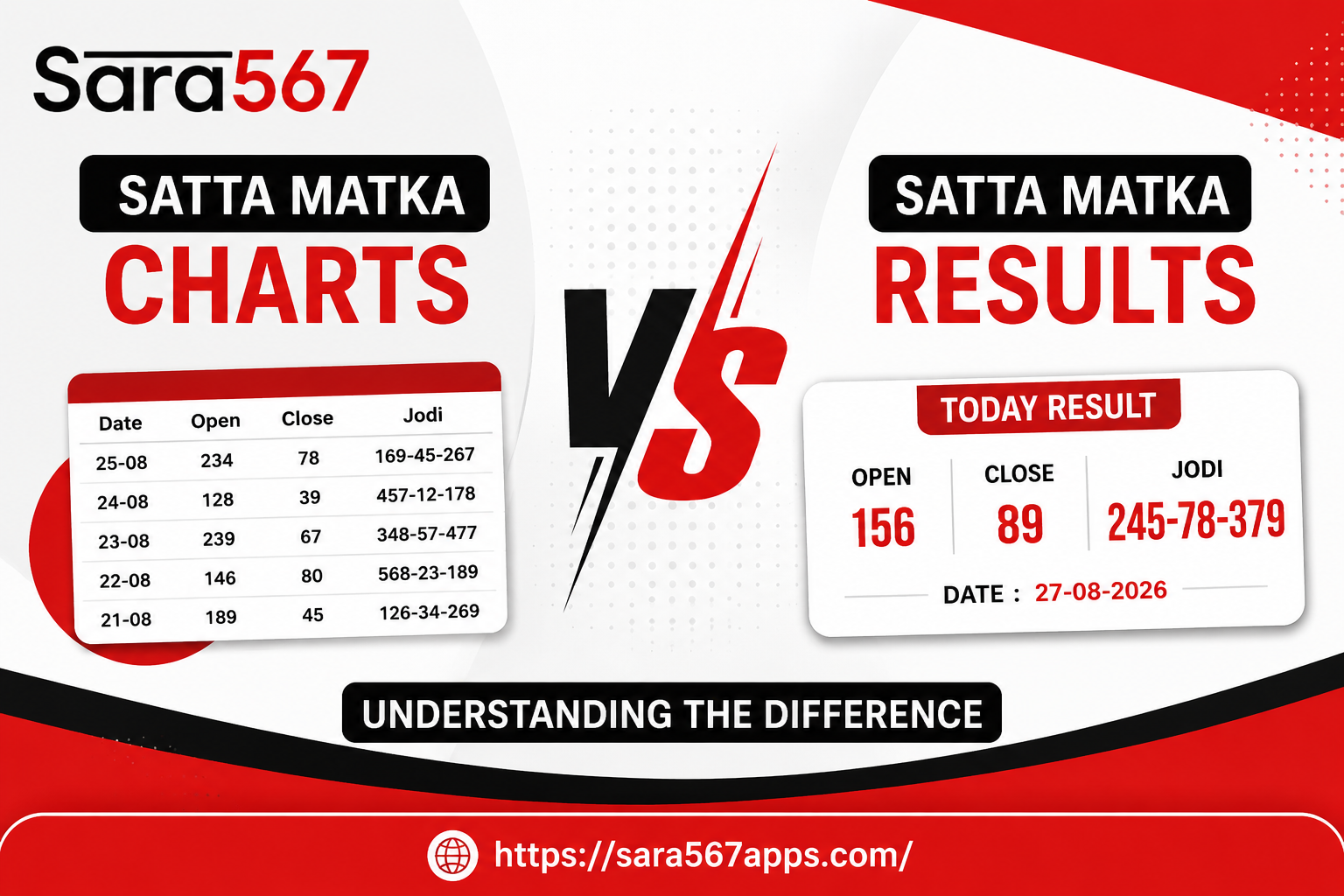
The world of traditional Indian game based on numbers can be overwhelming for newbies. The terms Jodi, Pana, Open Ank, Close Ank, Panel Chart as well as Live Outcome are often referenced in a variety of forums and websites. In these words two fundamental concepts commonly create confusion: Satta Matka chart and the Satta Matka chart and the Satta Matka result.
Although newcomers frequently confuse the terms they use, they serve specific functions in Matka domain documents. Knowing the distinction between charts and the results is crucial for those trying to study historical documents or navigate through educational sources or grasp the basics of Satta Matka terminology without getting overwhelmed by the jargon of specialized terminology.
This article explains the fundamental concepts of the field, compares their structure, and discusses how recognizing Satta Matka Chart and results distinction is important for general market research as well as for the use of reference.
What is a Satta Matka Result?
The Satta Matka outcome is the live or officially declared outcome for an individual market during an agreed opening or closing time. Originating from random draw processes involving the use of cotton or drawn cards, modern Matka markets release numeric results in the scheduled timing window of each day.
Key Characteristics of a Matka Result
-
Immediate Snapshot: The result can be described as a single event in time. It is able to answer "what number was announced right now?"
-
Session-based Updates: The majority of markets announce results in two distinct sessions: A Close result.
-
Numerical Formats: The full results set is typically comprised of three elements:
-
Pana (Patti): Open Pana (Patti) Open Pana (Patti): A 3-digit code that was announced in the beginning session (e.g."123").
-
Single Digit (Ank) Single Digit (Ank): A single-digit sum that is derived from the three-digit Pana (e.g. 1+2+3=6).
-
Closing Pana & Ank: An identical 3-digit set, with a one digit that is announced in the session's closing (e.g. 456 that yields 4+5+6=15using the last number 5).
-
Jodi is the two-digit number that is formed by combining both the Open single digit as well as close single digit. Close single digit (e.g. 65).
In the case of feeds with information, a full result sequence can look as 123-65-456. When a session ends the result announced becomes an integral part of the historic record.
What is a Satta Matka Chart?
An Satta Matka chart is a well-organized, historical grid or ledger that tracks the past performance of markets across a span of time, such as weeks, months or even years. Instead of displaying only the current outcomes, charts combine sequenced data into an organised archive.
Satta Matka Data
| RESULT | Single Real-Time Event 123 - 65 - 456 |
|---|---|
| CHART | Historical Archive Grid |
| Mon: 65 | |
| Thu: 10 |
Common Types of Matka Charts
Sites for informational reference generally show two types of charts:
- Jodi Chart: A type of calendar grid that displays only two-digit Jodi numbers that are declared for every one of week's days. It gives a neat perspective of previous day-to-day pairs.
- Panel Chart: (Pana Chart) The Panel Chart is a table which includes the 3 digit Close and Open Close Panas alongside the central Jodi number for each date.
Simply put, if a Matka result is just an individual snapshot, the Matka chart is the picture album which stores each snapshot in the course of.
Key Differences: Satta Matka Chart vs Result
Understanding the structural fundamentals between a chart as well as a result can help clarify the way information is displayed on the web portals for reference.
| Feature / Dimension | Satta Matka Result | Satta Matka Chart |
|---|---|---|
| Primary Definition | A single draw result is declared during a draw session. | A grid that shows historic past results and their period of. |
| Timeframe | Current, real-time or in immediate concentration. | Archival records that are long-term (weekly or monthly records). |
| Data Structure | A one linear sequence (e.g. for example,"123-65-456"). | Multicolumn table that is organized according to dates and days. |
| Update Frequency | The market is updated instantly according to specific timings for opening and closing. | The report is published once or twice a day when session results have been finalized. |
| Primary Purpose | Notifies you immediately of an public announcement about the outcome. | Historical reference to assist in research and records-keeping. |
| Target Audience Scope | Anybody looking to get immediate market information. | Students are analyzing the numerical record as well as layouts. |
How Charts and Results Are Presented on Information Platforms
Educational platforms organize these components differently, so that they do not confuse those who check for updates.
- Live Result: Tickers are typically placed in the upper right-hand corner of a mobile dashboard. They feature large fonts and live indicators, which draw attention to the most current open and closing figures.
- The historical Data Archives: Typically organized within menus with specific sections (e.g., "Kalyan Panel Chart" or "Time Bazar Jodi Chart"). These pages house huge data tables that are chronologically arranged from Monday to Sunday.
Informational platforms such as Sara 567 are public reference centers, offering well-organized Satta Matka terminology guides, live results notifications, as well as organized historical charts of the most popular segments of markets like Kalyan, Rajdhani, and Time Bazar. Websites such as Sara 567 concentrate on archiving historical data as well as providing clear language explanations to allow readers to look at numerical data with a standard design.
Essential Satta Matka Terminology
To comprehend charts and the results precisely, you must understand these common terms:
-
Matka: It was a traditional earthen vessel that was used to draw numbers. in the present, it's the mathematical genre that encompasses all system for predicting numbers.
-
Single (Ank): Any one digit in between 0 and 9 which is the result of mathematical addition.
-
Jodi (Pair): The mixture of two single numbers created by joining the Open single digit with the Close single one (ranging from 00-99).
-
Pana Patti / Pana: 3 digits number to be announced in a session of a market.
-
Single Pana (SP): Three unique digits (e.g., 123).
-
Double Pana (DP) Double Pana (DP): Two repeated digits, and a unique number (e.g. 112,).
-
Triple Pana (TP):identical numbers (e.g. 3333).
-
Time of Open and Close Time: The precise, scheduled dates when the market session starts and closes.
Why the Difference Matters for Beginners
Differentiating between a chart as well as the result is time-saving and avoids confusion.
- Make sure you avoid reading errors: Looking at charts from the past looking for live updates can lead to incorrect data. Being aware that the result is reflected in the current draw, whereas the chart is based on past results assists users to navigate databases online with precision.
- Explains Numerical Layouts: Newbies typically see sets such as 148-38-128 and are unable to understand what each one represents. Learning the way Pana combinators are combined into Jodi numbers helps make structured charts more comprehensible.
- Encourages objective Research: The recognition of the simple nature of charts as archives dispels the notion that they have "magic formulas." Charts are simply a record of past events without bias.
Common Misunderstandings
- Misunderstanding 1: "Charts Can Predict Future Results"

-
An explanation: Matka chart is only the historical record of prior events. The outcomes of a number are created randomly or by independent means; prior Chart entries don't dictate the future, provide assurance, or control outcomes in the future.
-
Misunderstanding 2: "Charts and Results Are Identical Terms"
-
An explanation: A result can be described as a single result for any given session. While a chart is an accumulation of outcomes recorded over the course of duration.
-
Misunderstanding 3: "All Charts Display the Exact Same Details"
-
Clarification: Different chart styles serve different record-keeping purposes. Jodi charts are able to track pairs of two digits as do Panel charts. Panel charts keep track of three-digit Pana sets in addition to the daily single-digits.
-
Misunderstanding 4: "Fixed or Guaranteed Numbers Exist in Charts"
-
Information sources that are reliable such as Sara 567 insist that there is no way for a platform to provide "fixed" or "guaranteed" figures. All claims that claim to guarantee accuracy or predictive methods are bogus.
Conclusion
The distinction between results versus satta matka charts is among the initial stages in acquiring the standard terminology used in markets. The result is a quick live output that is announced in the specified session. On the other hand, charts function as an organised historical ledger, which archives the past performance over a long period of time.
When you treat charting as historical grids and the results as one-time notifications, students can begin to explore the mathematical concepts and layout patterns in a neutral manner without falling prey to popular myths regarding prediction.
Frequently Asked Questions (FAQs)
1.What exactly is a Satta Matka chart?
The Satta Matka chart is a chart or table that provides past results, like daily Jodis or Panas, for specific dates and times for reference.
2.What is a Satta Matka result?
The Satta Matka results is the result that has been officially announced at an exact market period (Open or close) usually comprising three-digit Pana as well as a single digit Ank.
3.What is the difference between the Satta Matka chart, and the result?
The most significant difference lies in time and scope. Results are immediate one-time outcomes that are declared for a drawing session. However, a chart is a compiling historical chart that records multiple outcomes across months, weeks or days. months.
4.Are results and charts exactly the same?
They aren't exactly the same. Results are a single piece of information when it is announced while a graph is an archived collection of individual results that are displayed in a format that is structured.
5.The reason why people take a look at Satta Matka charts?
The majority of people look at Satta Matka charts primarily to look back at the history of markets in the past as well as to comprehend the basic performance patterns, and to study the standard Satta Matka terminology and formats.
Educational & Reference Disclaimer
This piece is only published to be used for historical, educational, as well as informational purposes. Satta Matka has financial risks and is not legally acceptable in all areas or areas. This information is not any financial advice, encouragement to gamble and tips on prediction, nor do they constitute methods for picking numbers. Platforms like Sara 567 serve as informative reference sites that provide historic data and market timings updates. They cannot guarantee the future outcome or advocate betting with real money.
Tab 2
SEO Title: Satta Matka Timings: Understanding How Markets Are Structured
Meta Description: Learn how Satta Matka timings are structured. Discover the difference between market opening, closing, result publication times, and market schedules.
URL Slug: satta-matka-timings-structure-explained
Primary Keyword: satta matka timings
Secondary Keywords: Satta Matka market timings, Matka timings, market timing meaning, Satta Matka market time, Matka market schedule, Satta Matka timing structure, market opening and closing time, Satta Matka terminology
How Satta Matka Market Timings Are Structured: A Beginner’s Guide
For anyone new to exploring traditional Indian number-based games, reading online information boards or checking market schedules can feel overwhelming. A major point of confusion for beginners is understanding how satta matka timings operate.
When looking at informational displays, you will see specific time stamps attached to different market names, such as Kalyan, Time Bazar, Rajdhani, or Milan Morning. Terms like Open Time, Close Time, Result Timing, and Market Schedule are often displayed side by side, making it tricky for newcomers to discern what each timestamp actually signifies.
This guide provides a neutral, educational breakdown of how Satta Matka market timing structures are organized, what the specific terms mean, and how to read market schedules clearly without confusion.
What Does “Satta Matka Timings” Mean?
In general Satta Matka terminology, the term satta matka timings refers to the fixed daily operational schedule assigned to a specific market segment. Unlike continuous financial markets or round-the-clock digital platforms, Matka markets operate around predefined time windows during which daily entries occur, sessions conclude, and outcomes are officially published.
A market timing structure defines the operational lifecycle of a market for a given day. It sets the exact parameters for when a market opens its first session, when that session closes, when the second session begins, and when the final daily session concludes.
Understanding these timestamps allows readers researching historical archives or educational portals to recognize which operational phase a given market is currently in.
How Market Timings Are Generally Structured
Most traditional and modern Matka markets follow a standardized two-session daily framework divided into distinct phases: the Morning/Day Session or Evening/Night Session, each consisting of an Open and a Close.
Here is a breakdown of how timing information is generally organized on reference platforms:
Satta Matka Market Schedule
| [OPENING TIME] | Session Starts (e.g., 04:10 PM) |
|---|---|
| ↓ | |
| [OPEN RESULT] | First Single/Pana Released |
| ↓ | |
| [CLOSING TIME] | Session Ends (e.g., 06:10 PM) |
| ↓ | |
| [CLOSE RESULT] | Second Single/Pana Released |
| ↓ | |
| [FINAL JODI] | Combined Daily Result Recorded (e.g., 123-65-456) |
1. Opening Time
The market opening time (often labeled as Open Time) marks the start of the first official session for a given market. At this designated time, the opening phase of the draw concludes, and the initial set of numbers—known as the Open Pana (a three-digit combination) and the Open Single (Ank)—is declared.
2. Closing Time
The market closing time (often labeled as Close Time) marks the end of the second session for that market segment. This timestamp indicates when the closing phase finishes, prompting the publication of the Close Pana and Close Single (Ank).
3. Result Publication Time
The result publication time refers to the exact moment when the compiled outcome for a session is posted to public data feeds or information boards. While the market closing time defines the operational end of a session, the result publication time is when the verified numerical sequence actually appears online.
4. Market Schedule
The market schedule is the overall timetable listing all operating markets alongside their respective opening and closing windows. Schedules categorize markets by time of day, generally falling into four primary operational bands:

- Morning Markets: Typically run between 10:00 AM and 1:00 PM.
- Day Markets: Typically run between 1:00 PM and 6:00 PM.
- Evening/Night Markets: Typically run between 7:00 PM and 11:30 PM.
- Main/Late Night Markets: Typically run up to midnight or early morning hours.
Satta Matka Timings vs. Result Timing
A common source of confusion for beginners is mixing up the general market schedule with the actual result publication timing.
- The market timing refers to the window during which the market session is active (e.g., a market scheduled from 04:10 PM to 06:10 PM).
- The result timing specifies the exact minute when the declared numbers are updated on reference boards (e.g., Open result published at 04:10 PM, Close result published at 06:10 PM).
Comparison of Key Timing Terms
| Timing Term | General Definition | Practical Example | Primary Function |
|---|---|---|---|
| Opening Time | The scheduled start time for the first daily session. | 04:10 PM | Indicates when the Open session outcome is declared. |
| Closing Time | The scheduled end time for the second daily session. | 06:10 PM | Indicates when the Close session outcome is declared. |
| Result Timing | The specific timestamp when data is published online. | Published at 04:12 PM | Informs users when new numeric updates are live. |
| Market Schedule | The complete timetable of operating hours across all markets. | Mon–Sat: 01:00 PM – 02:00 PM | Displays daily active hours and rest days for a market. |
Why Can Market Timings Differ?
If you examine multiple reference sites, you might notice slight variations in reported Matka market schedules. Several factors account for these differences:
- Market Specifics: Different independent markets (such as Kalyan Morning, Time Bazar, Rajdhani Night, or Main Bazar) maintain their own independent timetables established over decades.
- Regional Variations & Server Delays: Depending on hosting servers or geographical locations, result compilation feeds may experience minor delays of a few minutes before syncing across third-party portals.
- Day of the Week: Some markets operate six days a week (Monday through Saturday) and remain closed on Sundays, while others operate seven days a week.
- Source Differences: Informational portals display schedule information as provided by market organizers. Always check verified reference portals for updated schedule tables.
How Beginners Can Read Timing Information
When browsing informational displays or general educational resources on platforms like Sara 567, understanding how data is laid out helps prevent confusion.
Here is how a standard market entry appears on reference listings:
$\text{Market Name} \quad \vert \quad \text{Open Time} - \text{Close Time} \quad \vert \quad \text{Live Status}$
$\text{Example: } \mathbf{\text{Kalyan}} \quad \vert \quad \mathbf{04:10\text{ PM} - 06:10\text{ PM}} \quad \vert \quad \mathbf{\text{Market Open}}$
When viewing this information neutrally:
- The first time listed (04:10 PM) tells you when the opening digit sequence is published.
- The second time listed (06:10 PM) tells you when the closing digit sequence is published.
- The time gap between them (2 hours in this example) represents the duration of the market's daily cycle.
Informational platforms like Sara 567 provide structured reference directories that organize these timetables neatly alongside historical panel charts and term definitions, making it straightforward for readers to explore market schedules systematically.
Why Understanding Market Timings Matters
Recognizing how Satta Matka market timings are structured is essential for anyone studying the topic from an educational standpoint:
- Eliminates Confusion: Distinguishes between historical records (charts) and real-time operational status (timings).
- Helps Contextualize Data: Allows readers to understand why certain numbers appear on chart grids at specific times of the day.
- Prevents Misinterpretation: Helps beginners avoid mistaking scheduled operational timestamps for live, published results.
Common Mistakes Beginners Make When Reading Timings
-
Expecting the Complete Result at Opening Time
-
Mistake: Assuming that when a market reaches its opening time, the full result string (Open Pana, Single, and Close Pana) will be published at once.
-
Correction: At opening time, only the Open portion is declared. The complete Jodi (pair) cannot be formed until the Close time is reached hours later.
-
Assuming All Markets Share the Same Timings
-
Mistake: Thinking that every market listed on a portal opens and closes simultaneously.
-
Correction: Each market operates on its own distinct schedule distributed throughout the morning, afternoon, and night.
-
Confusing Market Schedule with Result Guarantees
-
Mistake: Believing that market timings imply guaranteed prediction times or fixed numbers.
-
Correction: Timings are purely administrative schedules indicating when random draw declarations occur; they carry no predictive value.
-
Ignoring Operating Days
-
Mistake: Looking for live timing updates on days when a specific market is officially closed (e.g., Sunday closures).
-
Correction: Always review the weekly schedule to confirm whether a market is active on a given day.
Conclusion
Understanding how satta matka timings are structured provides essential clarity for beginners researching traditional Indian market terminology. By learning to distinguish between opening times, closing times, market schedules, and result publication slots, readers can easily navigate informational directories and read market charts without confusion.
Whether exploring daily schedules or historical archives, treating market timings as structured administrative timetables ensures an objective, accurate understanding of how the market lifecycle is documented.
Frequently Asked Questions (FAQs)
1.What are Satta Matka timings?
Satta Matka timings refer to the established daily schedules that define when a specific market opens its first session, closes its final session, and publishes its numeric outcomes.
2.What does market opening time mean?
Market opening time is the scheduled time when the first session of a market concludes, resulting in the declaration and publication of the Open Pana and Open single digit (Ank).
3.What does market closing time mean?
Market closing time is the scheduled time when the second session concludes, marking the end of the market cycle for that day and releasing the Close Pana and Close single digit.
4.Are Satta Matka timings the same for every market?
No, timings vary significantly across different markets. Each market—such as Kalyan Morning, Time Bazar, or Rajdhani Night—maintains its own distinct opening and closing times throughout the day.
5.Does market timing mean the result is available at the exact same time?
Not always. While opening and closing times set the schedule, minor publication delays of a few minutes can occur while servers compile and verify the numerical outcomes before posting them to public feeds.
Educational Disclaimer
This article is written strictly for general educational, historical, and informational reference purposes. Satta Matka involves financial risk and may be subject to legal restrictions depending on your jurisdiction. This content does not promote, encourage, or facilitate gambling, betting, real-money wagers, or prediction strategies. Informational resources and reference sites like Sara 567 provide market schedules and term definitions strictly for informational awareness.