
Website Navigation Tips for Finding Matka Information Quickly
Website Navigation Tips for Finding Matka Information Quickly
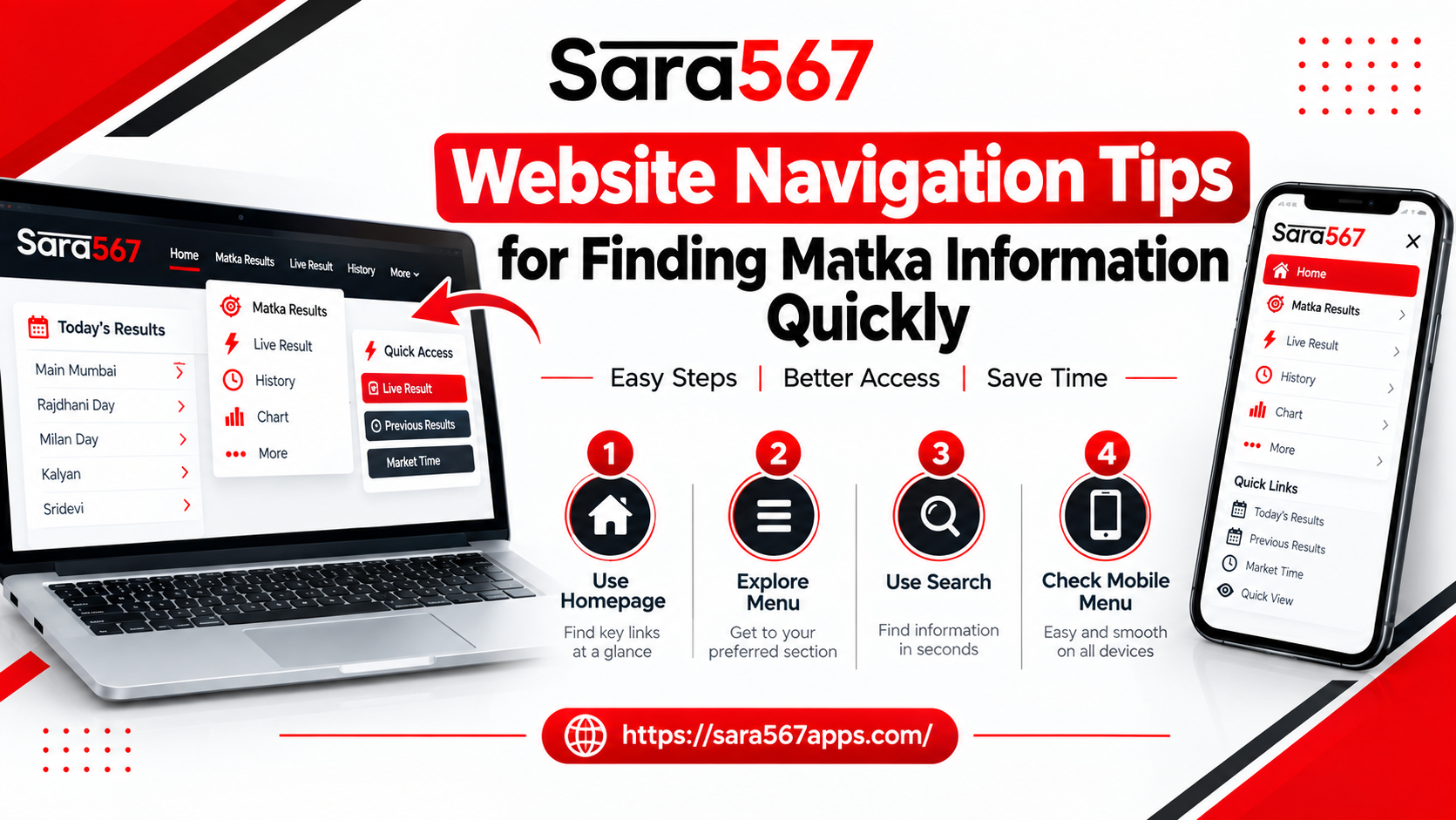
Website Navigation Tips for Finding Matka Information Quickly
A website can publish precise, up-to-date record keeping statistics, yet fail to properly organize those records for its audience. When browsing an online result portal, the goal of most visitors is usually to perform specific tasks - such as finding today's result pages, using date filters, visiting category archives, reviewing charts or reading contextual guides.
Poorly organized systems make it harder for visitors to accomplish these tasks by wasting their time on irrelevant links. Good website navigation acts as a roadmap that guides you to the precise information you are seeking without having to waste time on dead ends. By prioritizing ease of use and information architecture, you can simplify the browsing process significantly.
What Is Website Navigation?
At the most basic level, website navigation refers to any set of user-interface elements that allow you to move around a website. In practice, this can include everything from top menus, category links and footers to search bars and breadcrumb trails.
Well-designed navigation will answer these five questions at a glance:
- Where am I? (Page title, date and category should be clearly visible)
- What is here? (A good menu will list all the published records and relevant sections)
- Are there historical records? (Navigation should make it easy to find past data)
- How do I get to the homepage? (Should have an obvious link or button)
- Where are the contextual guides located? (Links to guides should be easy to spot)
If these elements are intuitive and straight forward, then you will have no trouble browsing through an information-heavy portal.
Start With the Main Menu
The primary navigation bar is usually located at the very top of a website. It is your first "official" indicator of how the site is organized. Instead of endlessly scrolling through a crowded homepage, the primary menu gives you an instant overview of the entire platform.
A well-organized primary menu will usually feature links such as:
- Home (the primary dashboard with high-level overviews)
- Today's results (current result pages with date/time filters)
- Historical records (past data organized by date)
- Charts and tables (visual representations of logged data)
- Categories (organized lists of individual markets)
- Guides (contextual overviews of site features)
Each link should have a descriptive label so that you can quickly identify which link will lead you to the information you need.
Use Categories to Narrow Down Information
Some result portals store thousands of individual records across hundreds of web pages. Instead of endlessly scrolling through multiple pages, use the category system to narrow down your search. Most platforms use a similar categorization system:
- Market categories (filter results by specific markets)
- Archive categories (group data by week, month or year)
- Guides (organized lists of article topics)
By clicking on a specific category, you will usually see a list of all relevant links. This is useful both for finding specific records and for browsing guides.
Look for Clear Page Headings
When visiting a new website page, always check the page heading to make sure you are on the correct page. A well-designed portal will always have descriptive labels that make it easy to identify the purpose of a given page.
When searching for result pages, always look for these three elements:
- Primary page heading (identifies the type of data)
- Clear date banner (shows the date for the current record)
- Table structure (lists the actual log entries in an organized manner)
- Warning badges (some entries may have additional notes)
By double-checking these labels, you can avoid common pitfalls such as confusing result logs with guide pages. This is especially important when browsing historical records, since many portals have separate sections for daily entries.
Use Dates to Find the Right Information
Date filtering is the most important tool for finding specific records. Since most portals update their records every day, always make sure to check the date before reviewing any log entries.
When browsing through historical records, look for these three types of timelines:
- Current day records (logs updated for the current day)
- Recent entries (data entries from the past few days or weeks)
- Older records (contains entries from months or years ago)
Always make sure to review the date banner when visiting a new table to make sure you are looking at the correct day. This will become especially important when cross-referencing historical entries with the current day's table.
Search Features Can Save Time
Many portals have extensive archives or guides sections that can contain thousands of pages. In these cases, it is best to use the search function to quickly locate relevant records.
If the portal has a search bar, try typing a specific date or category to narrow down your results.
After using the search function, always make sure to scan the page summary to make sure you have the right web page open.
Use Breadcrumbs and Internal Links
Breadcrumb trails are small navigational aids that show your current location on a website. They are usually located near the top of a web page, just below the primary menu.
A typical breadcrumb trail looks like this:
Home » Results » Archives » September 2026
Each trail acts as a mini menu, letting you jump to higher-level categories instantly. Another useful tool is internal links - these are special hyperlinks that appear inside articles or pages.
For example, if you are reading an article about website performance, it may have internal links to related topics such as our guide to why fast loading matters for online result websites or desktop vs mobile matka results. By clicking on these links, you can instantly access related topics without having to manually search for them.
Understand Tables and Charts Before Moving Between Pages
Tables and graphs are useful tools that summarize large amounts of data in an accessible format. Before moving between different table views, it is best to spend a few seconds reviewing the data to make sure you understand the context.
When looking at tables that summarize historical records, always make sure to review the column labels. With charts, always make sure to review the X-axis (horizontal axis) and Y-axis (vertical axis). This will tell you what type of data is being summarized by the chart.
Remember that charts and tables only summarize historical records for reference. They cannot be used as predictive tools since they only document past events.
A Simple Navigation Process
To make it easier to navigate through a new portal, try following this basic process:
- Start at the primary navigation bar
- Click on relevant categories to open new pages
- Make sure the page heading matches the information you need
- Review the date banner to make sure you are looking at the right day
- Review table summaries before reviewing any log entries
- Use internal links to instantly jump to related topics
- Use breadcrumbs to return to higher-level categories
This simple process should make it easier to navigate through most portals without getting lost.
Common Website Navigation Mistakes
Even the best portals can have confusing or misleading navigation elements. Here are some common mistakes that you should avoid when browsing a result portal:
- Assuming that result pages show the latest data (always check the date banner)
- Confusing different categories (make sure to review the page heading)
- Missing warning banners (some entries may have special notes)
- Accidentally using the back button (always use breadcrumbs to return to previous pages)
- Thinking that charts are predictive tools (these only summarize historical records)
By double-checking basic labels, you can avoid many common pitfalls at once.
Desktop and Mobile Viewports
Most portals use different navigation systems for desktop and mobile users. Understanding the differences will make it easier to browse both viewports.
| Desktop | Mobile |
|---|---|
| Horizontal menu bars | Vertical "hamburger" menus |
| Sidebar widgets | Collapsible widgets |
| Tables with multiple columns | Tables with vertical columns |
| Wide graphs | Graphs that respond to swipes |
To explore the differences in more detail, you can review our guide to what makes a good online matka results dashboard.
How Clear Navigation Helps Website Visitors
Logical Matka Website Navigation makes it easier for website visitors to accomplish specific tasks. First, they can always find the information they need by using breadcrumbs or internal links. Second, the consistent structure lets them scan the page for relevant headings and summaries. Third, intuitive navigation makes it easier to read guides and understand the connection between published topics.
For example, most well-structured portals will have consistent table summaries across different date views. This lets a visitor instantly recognize familiar elements in different table formats. Similarly, good navigation makes it easier to follow internal links between guides and actual records. These connections may include topics such as how online matka websites present market information.
With logical navigation, you can instantly focus on the most important elements on a given web page.
Information Navigation Vs Outcome Prediction
It is important to separate information navigation from outcome prediction - the two concepts are completely different.
| Website Navigation | Outcome Prediction |
|---|---|
| Purpose Helps you find existing information | Attempts to predict an unknown outcome |
| Tools Menus, categories, search bars, links | Guesswork, assumptions, patterns |
| Information Source Historical data (actual log entries) | No information source |
| Usability Benefits the end-user | Benefits no one |
Logical navigation only helps you find relevant information faster. It cannot and does not attempt to predict future results. Likewise, outcome prediction has no bearing on the usability of a website.
Conclusion
Mastering Matka Website Navigation is a matter of using basic tools to find information faster. Whether you are browsing on a desktop or a mobile device, make sure to always check the page heading and date banner. Following these simple steps will help you avoid common pitfalls such as reviewing historical records when only current entries are needed. By organizing information intuitively, you can make it easier for other visitors to use a given portal.
Also Read: Understanding the Difference Between Result History and Live Updates
Frequently Asked Questions
1. What is Matka website navigation?
Matka website navigation refers to any combination of menus, category links, search bars, breadcrumbs and internal links that help you find result pages, historical records or guides on a result portal.
2. How can I find result information quickly on a website?
Use the primary navigation bar to find the category that you need. Always check the page heading and date banner when you arrive at a new page. You can also use search and internal links to instantly jump to specific sections.
3. Why are dates important when browsing result pages?
Dates give you important context about a given record. Since most portals update their daily records regularly, make sure to always check the date to avoid reviewing outdated information.
4. How can search and categories make website navigation easier?
Categories let you jump to relevant records without browsing irrelevant content. Search features let you type specific phrases to instantly jump to the information you need.
5. Can website navigation help predict future results?
No. Website navigation only helps you find existing information faster. Outcome prediction is not a valid concept in website usability.