
Understanding Matka Odds & Probability
Understanding Matka Odds & Probability
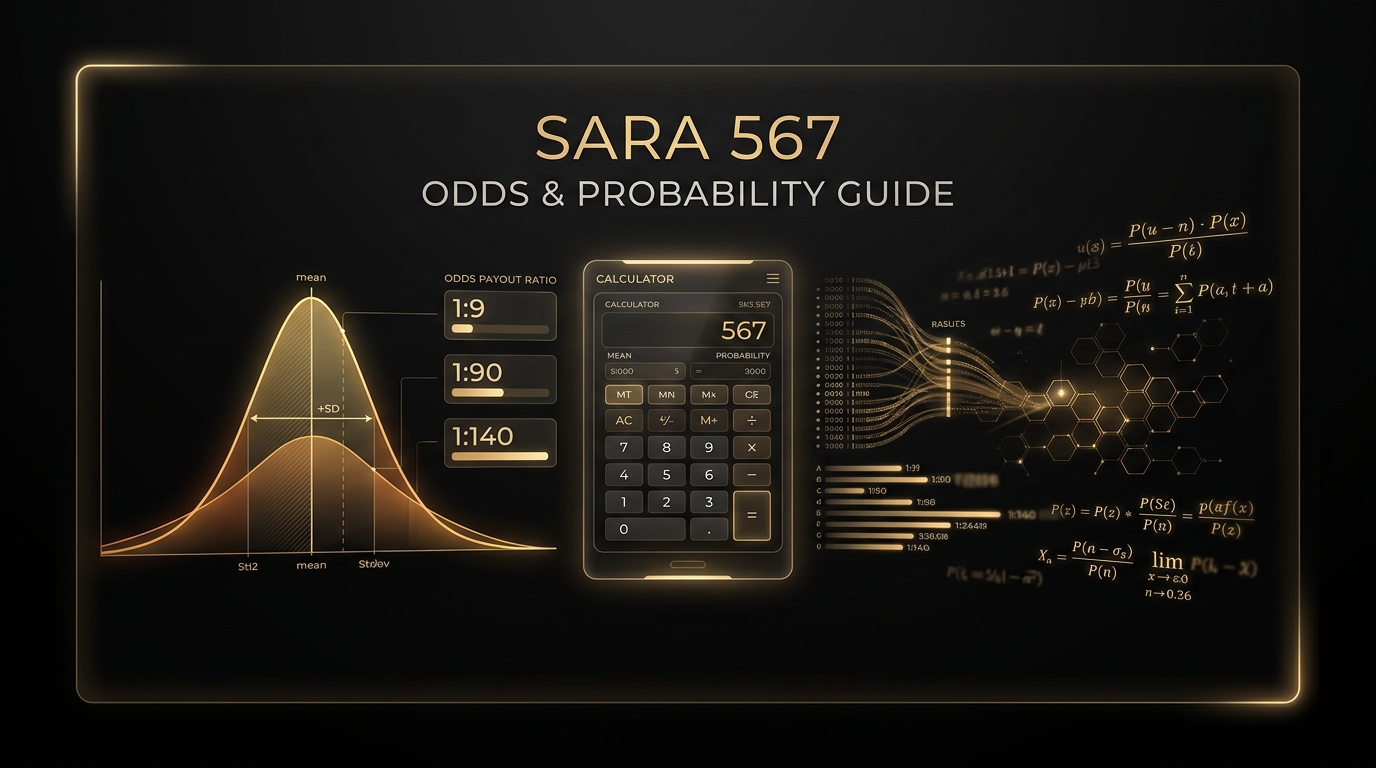
In the world of number-based gaming, many players rely on lucky charms, astrology, or emotional intuition. However, beneath the rituals and folklore, Satta Matka is governed entirely by mathematical laws: probability, permutations, and statistical distributions.
Understanding matka odds and probability is the single most valuable skill you can develop as an informed player or market observer. It shifts your perspective from unrealistic wishful thinking to analytical clarity. By knowing the exact mathematical probability of each outcome, you can make informed decisions, manage your bankroll prudently, and separate genuine market data from baseless superstition.
Following our foundational Complete Beginner's Guide and our walkthrough on How to Read Matka Charts Like a Pro, this guide breaks down the mathematics of Satta Matka into simple, transparent concepts.
The Mathematical Foundation of Satta Matka
Every outcome in a Matka market is drawn from a discrete, finite sample space.
Whether an outcome is generated through physical token draws or digital Random Number Generators (RNG), the basic formula for probability remains constant:
$P(E) = \frac{\text{Number of Favorable Outcomes}}{\text{Total Number of Possible Outcomes}}$
Because digits are drawn uniformly, each number from 0 to 9 has an equal mathematical likelihood of appearing in any given independent draw. Let us calculate the precise odds across every major format.
Probability Breakdown Across Different Game Types
1. Single Ank (Single Digit)
In a Single Ank draw, you choose one digit between 0 and 9.
- Total Possible Outcomes: 10 (
0, 1, 2, 3, 4, 5, 6, 7, 8, 9) - Favorable Outcomes: 1
- Probability: $P(\text{Single}) = \frac{1}{10} = 10%$
- True Mathematical Odds: 9 to 1
2. Jodi (Two-Digit Combination)
A Jodi combines the Single Ank of the Open session and the Single Ank of the Close session to form a number between 00 and 99.
- Total Possible Outcomes: $10 \times 10 = 100$ combinations
- Favorable Outcomes: 1
- Probability: $P(\text{Jodi}) = \frac{1}{100} = 1.0%$
- True Mathematical Odds: 99 to 1
3. Pana / Patti (Three-Digit Combinations)
Panas are three-digit numbers chosen in ascending order ($a \le b \le c$). There are exactly 220 total valid Panas in the traditional Matka panel:
- Single Pana (SP): 120 unique combinations with 3 distinct digits (e.g.,
123,456). - Double Pana (DP): 90 combinations with 2 repeated digits (e.g.,
112,338). - Triple Pana (TP): 10 combinations with 3 identical digits (
000, 111, 222, \dots, 999).
The probability depends on which category of Pana you analyze:
- Any Specific Pana: $\frac{1}{220} \approx 0.455%$
- Any Single Pana (SP): $\frac{120}{220} \approx 54.55%$ of all panel outcomes
- Any Double Pana (DP): $\frac{90}{220} \approx 40.91%$ of all panel outcomes
- Any Triple Pana (TP): $\frac{10}{220} \approx 4.55%$ of all panel outcomes
Comprehensive Odds & Payout Ratio Comparison Table
Understanding how payout ratios compare with true statistical odds reveals how the market operates:
| Game Format | Total Outcomes | Mathematical Probability | True Odds | Standard Market Payout |
|---|---|---|---|---|
| Single Ank | 10 | $10.0%$ | 9 to 1 | 9 : 1 (or 9.5 : 1) |
| Jodi | 100 | $1.0%$ | 99 to 1 | 90 : 1 (or 95 : 1) |
| Single Pana (SP) | 220 (120 SP) | $\approx 0.71%$ per Ank | 139 to 1 | 140 : 1 (or 150 : 1) |
| Double Pana (DP) | 220 (90 DP) | $\approx 1.11%$ per Ank | 279 to 1 | 280 : 1 (or 300 : 1) |
| Triple Pana (TP) | 220 (10 TP) | $\approx 0.45%$ per Ank | 699 to 1 | 700 : 1 (or 800 : 1) |
| Half Sangam | 2,200 | $\approx 0.045%$ | 2,199 to 1 | 1,400 : 1 |
| Full Sangam | 48,400 | $\approx 0.002%$ | 48,399 to 1 | 10,000 : 1 |
Note: Payout ratios vary slightly across regional bookmakers and mobile apps, but the statistical probabilities remain constant everywhere.
Expected Value (EV): The Math Behind Sustainable Play
In probability theory, Expected Value (EV) determines the average financial outcome of a repeated decision over time:
$EV = (P(\text{Win}) \times \text{Payout}) - (P(\text{Loss}) \times \text{Stake})$
For example, on a ₹100 Single Ank wager with a standard 9:1 payout: $EV = (0.10 \times ₹900) - (0.90 \times ₹100) = ₹90 - ₹90 = ₹0$
When payouts equal true mathematical probability, the expected value is neutral. However, in games where payouts are slightly lower than the reciprocal of probability (e.g., 90:1 payout for a 1:100 chance), there is a built-in house margin.
Recognizing this mathematical reality teaches players two vital lessons:
- No system beats probability in the long run.
- Short-term swings must never be mistaken for permanent winning formulas.
Common Probability Myths in Satta Matka Debunked
Myth 1: "The Law of Averages Guarantees My Number Next"
This is the classic Gambler’s Fallacy. If the Kalyan market has declared Open Ank 4 five days in a row, the probability of 4 appearing tomorrow remains exactly $\frac{1}{10}$ ($10%$). Random events do not have memory; past draws do not influence future physical or RNG outcomes.
Myth 2: "Certain Numbers Are Naturally Luckier Than Others"
Historical frequency charts on Sara 567 Charts may show minor variance in number distributions over a short period. However, across thousands of draws, the distribution curve flattens out according to the Law of Large Numbers. Every digit from 0 to 9 has an equal statistical share.
Myth 3: "Paid Guessing Groups Know the Exact Number"
Any group or individual claiming guaranteed "fixed leak" numbers is mathematically fraudulent. Independent market sessions cannot be predetermined.
Why Sara 567 Promotes Mathematical Literacy
Unlike rogue websites that promote fraudulent "fixed leak" numbers to exploit newcomers, Sara 567 is built on transparent data principles:
- Clean Historical Data: We provide accurate Jodi and Panel charts so enthusiasts can conduct genuine statistical studies.
- Fast Live Updates: Unbiased, real-time results for all major bazars, including Kalyan, Milan, Rajdhani, and Time Bazar.
- Mobile Convenience: Follow charts on your smartphone or through our fast Android application via our how to play guide.
- Responsible Gaming Culture: We actively advocate for budget discipline, emotional control, and age compliance.
Essential Guidelines for Responsible Gaming
- Set a Strict Entertainment Budget: Only participate with discretionary funds that you can comfortably afford to lose.
- Never Bet on Borrowed Money: Never use funds allocated for living expenses, rent, groceries, or debt repayment.
- Avoid Chasing Losses: Emotional "revenge betting" exponentially increases financial risk.
- Age Verification: Platforms are strictly intended for adults aged 18 and older. Review our comprehensive disclaimer and terms prior to engaging.
Frequently Asked Questions (FAQs)
1. What is the easiest format to calculate in Satta Matka?
Single Ank is the easiest format, with an exact 1-in-10 ($10%$) probability and a standard 9:1 payout ratio.
2. What are the odds of winning a Jodi bet?
The probability of picking a winning Jodi is 1 in 100 ($1%$), as there are 100 possible pairs from 00 to 99.
3. What is the difference between true odds and payout odds?
True odds represent the actual mathematical probability of an event occurring (e.g., 99:1 for Jodi). Payout odds represent the ratio paid by the market upon winning (e.g., 90:1). The difference represents the operator margin.
4. How many total Panas exist in Satta Matka?
There are exactly 220 unique valid Panas, comprising 120 Single Panas (SP), 90 Double Panas (DP), and 10 Triple Panas (TP).
5. Can chart reading change the mathematical probability of a number?
No. Chart reading helps you study historical frequency trends and past cycle records, but the fundamental mathematical probability of each new draw remains constant and random.
6. Where can I study live market outcomes and historical charts?
You can explore comprehensive live updates and archived records across all major markets on Sara 567.
Continue expanding your knowledge: check out our Beginner's Guide and our walkthrough on How to Read Charts.