
What Is Half Sangam and Full Sangam in Satta Matka? | Sara 567
Understanding the historical models of display requires a clear understanding, an ability to think critically, as well as a clear line between the records of past events and those for forthcoming events. If you are a beginner to the Matka market, looking at tables that are populated with three-digit numbers and two-digit ones may feel as if you're trying to figure out the intricate puzzle.
This tutorial explains the satta matka chart from an educational perspective. Through understanding how documents are organized by recognizing typical analytical traps and using sources like Sara 567 with care, students will be able to gain a better understanding of how data from charts functions.
What is a Satta Matka Chart?
In essence, an Matka chart is just the structure of a historical record. It records past results numerically produced by certain market timing sessions, which can span months, weeks or days. Months. Instead of serving as an instrument for prediction, charts function as an archive of previous events. Charts that are standard typically have two major types:
- Jodi Charts: Show two-digit outcomes that have been recorded as the daily results of markets.
- Panel charts (Patti Charts): display three-digit combinations with their single-digit equivalents.
From a pedagogical perspective In terms of education, reading a chart is studying how data is organized by chronological gridlines, columns and rows. This helps users track publication historical data in a standard layout.
Why Beginners Often Misunderstand Chart Reading
The main reason that newcomers have difficulty when it comes to satta matka charts is due to a mental state that is known as pattern searching. Human brains are naturally equipped to recognize patterns and make connections in totally random, unrelated events. If a newcomer is looking at historical numbers tables, they usually think that numbers of the past are the basis for subsequent numbers. The result is a variety of misinterpretations:
- Confusion of History and Probability: Assuming that since the number isn't appearing recently, the number is "due" to appear.
-
Avoid Visual Pattern Assumptions: The mistake of interpreting visually aligned colors as diagonal, vertical or repetitive color codes indicates an unassailable pattern.
- Making Records Maps: Historical archives can be viewed as blueprints to model predictively as opposed to the passive records.
Haan, current table thodi confusing hai, especially “Secret Patterns” aur “Guaranteed Outcomes” wali lines natural nahi lag rahi. Isko beginner friendly aur educational way mein aise structure karna better rahega.
Common Satta Matka Chart Reading Mistakes to Avoid
Beginners often make simple mistakes while reading historical Satta Matka charts. Understanding these mistakes can help readers interpret chart records more carefully without treating past results as guaranteed predictions.
| Common Mistake | Why It Can Be Misleading | Better Approach |
|---|---|---|
| Looking for hidden patterns | Repeated numbers or similar sequences in old records do not automatically indicate a fixed pattern. | Treat repeated results as historical observations rather than guaranteed signals. |
| Assuming past results predict future results | A previous outcome does not determine what will happen in a later session. | Keep each result separate and use charts only to understand historical records. |
| Trusting every chart without checking | Incomplete, outdated, or incorrect records can create a misleading picture of past results. | Compare information with reliable and clearly presented chart records. |
| Confusing visual patterns with meaningful trends | Diagonal, vertical, colour based, or repetitive arrangements can look significant even when they have no proven predictive value. | Focus on the actual numbers and dates instead of visual arrangements alone. |
| Expecting guaranteed outcomes | Historical charts cannot provide certainty about future results. | Use charts for reference and historical understanding, not as a guarantee of future outcomes. |
- Treating Independent Events as Dependent
Each draw or outcome within a standard Matka mechanism is independent from previous draws. The most common mistake in Matka charts is the assumption that previous numbers have the weight of forward-looking events. Mathematically, the past results are not a factor in determining the baseline of statistics for new events.
- Misinterpreting Visual Layouts
Charts make use of columns (often each week's days) as well as rows (weeks of the month). Many beginners are caught using diagonals to read or skip the rows that alternate to build "formulas." These alignments in the visual are just a consequence of grid layouts, and are not mathematical rules inherently.
- Ignoring the Breakdown of Elements
Panel charts contain several layers of information. Uncertainty about what each digit means can lead to confusion.
| Chart Element | What It Represents | What Beginners Should Understand |
|---|---|---|
| Three-Digit Panel | The 3-digit initial combination | The raw structural parts of session records. |
| Single Digit (Sum) | The unit number is taken from the panel | Explains the basics of maths that are modular (addition sums). |
| Jodi Pair | Close and open single numbers | This entry represents the daily pair within the archive. |
How to Read Historical Data Responsibly
Charts that are solely for reference needs a well-organized and neutral mind. This is how novices can study charts to avoid falling into common traps:
- Concentrate on Data Literacy: Find out how close, open, and jodi numbers are calculated mathematically, without attaching the value of predictive to them.
- Distinguish Fact from Prediction: Consider that the historical records provide evidence of what has happened, not the future.

- Know Randomness: Be aware that numerical sequences within independent systems are not governed by the human mind or follow commercial "guessing formulas."
Using Sara 567 as an Educational Reference
If you are interested in understanding how the historical data on market trends is stored by using a tidy and frequently up-to-date reference platform can be helpful. Sara 567 offers structured, easy-to-read displays of historical charts to help you learn more about them.
What Beginners Can Learn From Satta Matka Charts
By reviewing historical records on Sara 567, beginners can become familiar with the basic structure and presentation of Satta Matka charts. They can learn how different records are arranged and how to read the information without making assumptions about future results.
-
Understand Chart Layouts: Learn how Jodi and Panel records are displayed across daily and weekly chart formats.
-
Identify Open and Close Records: Understand how open and close results are presented and where they appear within a chart.
-
Focus on Historical Data: Use the available records to understand past results instead of relying on claims or predictions from unverified sources.
Responsible & Legal Considerations
It is crucial to have an open mind when you research Matka charts:
- Learning Scope: Observing charts is a way of to understand data archives and is not an investment strategy.
- No guarantees or promises: The tools and systems, such as a chart reader or analyst is able to provide precise predictions or warrants.
- Legal awareness: Gaming with real money is regulated by laws and restrictions based on the jurisdiction you reside in. Be sure to adhere to the local legal guidelines and put a high priority on responsible awareness.
Conclusion
Understanding the fundamentals of understanding satta matka chart reading is a matter of knowing the fundamentals of archives from the past. Charts function as precise, well-organized documents of the past performance of markets, nothing more or less. Through avoiding the common pitfalls like seeking patterns, knowing the independent results and using clear platforms such as Sara 567, which is a platform for learning by observation, beginner traders can navigate charts information with precision and knowledge.
Frequently Asked Questions (FAQs)
Q1: Can satta matka chart reading help predict future numbers?
No. The Satta Matka charts are logs of historical events of the results in the past. Since each outcome is an individual event that cannot be predicted by past results, they are not able to forecast the outcome of future events.
Q2: What's the primary distinction between the Jodi Chart and a Panel Chart?
The Jodi Chart records two-digit daily results, while the Panel Chart records the three-digit combination (patti) together with single-digit sums, for both session open and closed.
Q3: What's an example of the "Gambler's Fallacy" in chart study?
The mistaken assumption is that if an exact number or digit isn't appearing in the past, it's "due" to appear soon. In independent events, past occurrences do not change future odds.
Q4: What is the reason people draw patterns and lines in Matka charts?
People draw lines in order in order to find visual repeats or patterns. But, the patterns they draw appear to be visual oddities arising from grid format, and not real mathematical laws.
Q5: What is the best way for beginners to make use of Sara 567 when they need to chart read?
Beginning students should utilize Sara 567 for a simple basis to understand how data from the past is arranged, classified and formatted in different time frames in the market.
Tab 2
Meta Title: How Historical Satta Matka Charts Are Organised: A Beginner's Guide
Meta Description Discover how the historical Satta Matka charts are structured. Examine the panel layouts Jodis, layouts, as well as the data structure for Sara 567, from an educational viewpoint.
URL Slug: how-historical-satta-matka-charts-are-organised
date: "2026-08-26"
Excerpt: Historical Satta Matka charts can look confusing at first, especially for beginners. This guide explains how these charts are usually arranged, what the different numbers and sections mean, and how to read them for learning and reference. It keeps things simple so you can understand the basic chart format without assuming that past results can predict future outcomes.
How Historical Satta Matka Charts Are Organised
When you examine archives of Matka records first it could appear to be an overwhelming pile of numbers. The rows of 3-digit numbers sit next to two-digit numbers. These are set in a grid of days of the week and names of markets.
If you're looking to understand the data solely for educational reasons, knowing how the historical charts of satta matka are organized is the most effective starting point.
Similar to financial archives and historical tables of sports chart, these are arranged journals of previous events. They document the published outcomes by date, resulting in a standardized list of previous outcomes. This article explains the process of putting these charts together, the meaning of each section is, and the best way to look at them with an objective, grounded mindset.
What Are Historical Satta Matka Charts?
In their essence, the historical Satta Matka charts are chronological archive of market sessions' results. They provide published data for specific weekly, daily or monthly intervals.
A lot of novices come across these archives when trying to comprehend how previous sessions' results are recorded. From a pedagogical perspective it is important to understand the things they are: records that passively record past instances. They function as a record of the past and will not serve as predictors of future events, models, or dependable indicators for future events.
Why Are Historical Charts Organised?
If thousands of numbers published over the years were presented in one unstructured stream searching for information from the past could be nearly impossible. The systems organize records from the past in a variety of rational reasons.

- Simple Reference: The grid is structured to let readers easily find dates and weeks or even market times.
- Systematic Record-Keeping: Organizing results into regular columns and rows, ensures long-term records are identical across various platforms.
- Chronological Comparative: The clean design lets you easily observe the way that numbers were recorded across the course of a month or a day.
- Clear Categorization: Layouts that are standard break down various components of drawing- such as open sessions, closed session, single numbers and panels into distinctive visual elements.
Historical Satta Matka Charts Are Organised
The majority of the historical Matka archives use a clear grid based on a calendar. The format is what defines how weekly and daily data appear across different markets.
1. Calendar Rows and Weekly Grids
Charts are usually divided into calendar weeks. Every main row is one week (often that runs from Monday to the weekend or on Sunday). To the left side on the diagram, you'll generally see the dates range, or week number that defines the duration for the particular row.
2. Daily Columns
Columns are the weeks days. Each day's grid shows the session records for that date in the calendar.
3. Session Subdivisions (Open & Close)
Every daily column is broken into two sessions of operation:
- Open Session: Initial results were announced during the beginning part of the timing of market events.
- Close Session: The official results were released following the close of the timeframe for market transactions.
Understanding the Main Elements of a Historical Chart
To comprehend the chart line-by-line is to be able to comprehend the different numerical components that are included in every daily block.
| Chart Element | What It Represents | What Beginners Should Understand |
|---|---|---|
| Date / Week Row | The calendar year in the archive | Sorts the records chronologically according to week to allow for clear and precise historical monitoring. |
| Three-Digit Panel (Patti) | The original 3-digit number combination released | Shows the 3 digits of raw data recorded during sessions that are either open or closed. |
| Single Digit (Sum) | The unit number is derived by the panel | Calculated by adding three panel digits with the final number. |
| Jodi Pair | A two-digit combined entry | Created by putting an Open single digit in front of the Close single number. |
The Three-Digit Panel (Patti)
The panel consists of a set of digits that are released for a specific session (for instance, 2-3-5). The panel charts of the past show these digits for both Open as well as Close sessions.
The Single Digit
The single digit comes from the panel by using modular addition. The three numbers of the panel are combined in the end, and then the last one of the three is derived. As an example, if a panel's total is two plus three + five =, then the one zero is zero.
The Jodi Pair
It is a Jodi is a figure with two digits that is created by mixing two digits: the Open single digit and the Close single digit. In the case that the Open single number has a value of three with the Close number has 8 The historical Jodi of that time period was 38.
How Beginners Can Read a Historical Chart
Understanding an archived chart in a systematic manner is easy once you understand the flow of the layout. Below is a guide to reading historical chart data:
- Choose to view the Market Archive Choose the particular market chart that you wish to see, since each market has its own unique timing program.
- Find the timeframe: Scroll to the calendar year, month, or the specific week row you'd like to examine.
- Read across the Week: Move from left to right on the line, and note the results reported from the beginning of the week to the final day each week.
- Differentiate the Session Data Notice which numbers are the panel for Open sessions, those that are the panel of Close sessions and the method by which the central Jodi pair was constructed.
Common Mistakes Beginners Make
While looking at the historical charts of satta matka , newcomers can often miss the chart they're looking at. By avoiding these traps, you can keep an honest, objective viewpoint:
- Are you looking for guaranteed patterns: Assuming that visual patterns or repeated numbers in a grid are an "secret formula." Grid layouts can create natural patterns that are visually appealing, however they are only layout effects, not mathematical principles.
- treating repeated numbers as predictions: Expecting a number which appeared in consecutive days to reappear.
- The Gambler's Fault: Believing that because the digit you're looking for hasn't shown up in a number of weeks, it's "due" to show up.
- Relying on unverified records: Studying charts from non-reliable sources, which contain mistakes or numbers that have been altered and distortions in historical accuracy.
- Confusion of Archival Logs and Forecasting Relating a past log as a guide for the future, not an inactive record of the historical events.
Historical Data vs Future Predictions
The distinction between the past and forecasts for the future is crucial in analyzing any numerical data.
| Feature | Historical Data | Future Predictions |

| :--- | :--- | :--- | | Definition | Records that are verified of the events that have been observed. | The estimation or speculative description of events that haven't been observed. | | Certainty | Absolute static, and perpetual once released. | Unverified and unproven. | | Function | serves as an archive source. | Claim to foresee independent outcomes for the future. | | Impact of History | Recordings of previous events chronologically. | It is not possible to determine this through past events that have occurred in separate systems. |
If you are in a system where results occur independently, the previous entries in logs have no influence on the later incidents. Charts from the past tell you the events that occurred but however, they do not tell you the future events that will occur.
Exploring Historical Charts on Sara 567
In the case of those who are interested in understanding the way historical charts are formatted and archived using a simple reference tool will be beneficial. Sara 567 offers well-organized visual representations of data from historical charts to aid in informational research.
Through a study of historical documents on Sara 567, students could:
- Take note of how Panel or Jodi charts are categorized across clear weekly and daily grids.
- Examine how various timeframes in the market arrange how they organize their Open session and Close session record.
- Train your eyes on the standard chart components without having to rely on obscure or untrusted Third-party sources.
Utilizing Sara 567 solely to serve as a reference for education lets you become familiar with the standard layouts of data and maintain a clear, solid understanding of old documents.
Tips for Understanding Historical Chart Information
For you to keep your attention on reading while remaining responsible and practical Keep these suggestions on your list:
- Keep an Archival mindset: Treat every chart as a historic table within the encyclopedia or database.
- Review Information Sources: Verify the validity of archives by cross-referencing them on platforms such as Sara 567 to make sure you're looking at the correct historic entries.
- Respect Independent Event: Remember that past figures do not affect any future probability.
- Learn the Legal Background: Stay aware of local laws and guidelines in relation to Matka actions in your area making sure you have a clear and responsible understanding throughout the day.
Also read: Time Bazar Chart Guide: Jodi and Panel Records Explained
Conclusion
Knowing the way the historical Satta Matka charts are structured can be understood by realizing their purpose as archives of data. In arranging the past's results in weekly rows, daily panels, columns, and jodi pair charting provides an easy way of referencing the historical data. They can help avoid common errors such as pattern-seeking under control by recognizing the distinction between the logs of past events and those for those to come, and using simple reference resources like Sara 567, novices can navigate chart data using a clear attitude.
Frequently Asked Questions (FAQs)
Q1: What is the purpose of historic satta matka charts utilized to help you?
The historical Satta Matka charts are used as reference documents that are passive. The charts allow users to search for, confirm and review outcomes of session sessions published in the past months, days or even decades.
Q2: How can studying past charts aid in predicting future trends?
No. Historical charts are a record of historical events but only. Since each session's draw operates independently, the historical records can't predict or ensure the future outcome.
Q3: What's the distinction between the Open session or a Closed session on charts?
The Open session is the first to record figures that are released at the beginning of a block's timing The Close session records the closing figures published at the conclusion of the block.
Q4 What is the way that the number with two digits in it (Jodi) computed in a chart?
Jodi is formed by placing the Jodi is made by putting the single digit from the Open panel alongside the single digit taken by the Close panel.
Q5: What can novices do to make use of Sara 567 in order to gain knowledge about charts?
For beginners, it is possible to use Sara 567 to learn about the resource to see the way historical data, panel sets and jodi pair are arranged on standardized daily and weekly grids.
Tab 3
SEO Title: Matka Number Formats Explained: Single, Jodi, and Pana
Meta Description Discover the fundamental structures of Matka numbers and formats. Find out the meaning behind what Single, Jodi, and Pana are in conventional chart language with this beginners guide.
URL Slug: matka-number-formats-single-jodi-pana
The primary keyword: matka numbers formats
Secondary Keywords: One number's meaning Jodi numbers, number significance Pana number's significance, Matka terminology, Matka chart, Single Jodi Pana, Matka numbers explained Matka glossary, basic Matka terms
Understanding Matka Number Formats: Single, Jodi and Pana
The process of reading through historic data such as analytical guides or charts for reference will require an understanding of the specialized terminology. If you are introducing Matka numbers chart terms at first the various names and structures of digits could be difficult to understand. Words like "Single," "Jodi," and "Pana" appear frequently across the reference literature, but their definitions for structural elements are seldom defined in a simple manner.
This instructional guide offers an unambiguous breakdown of commonly used matka-style number format. Its purpose is solely informational in order to clarify these terms, define the differences in their structure and assist beginners in understanding the basic chart language without confusion or confusion.

What Are Matka Number Formats?
The traditional reference systems matka numbers represent distinct classifications of numbers, that are based on the number of digits they contain. In contrast to referring only to the results or computations, these terms just describe the way that numbers are organized and presented in informational charts.
The various terms like single, Jodi, and Pana are used to group numbers into two-digit, one-digit or three-digit formats.
- Single: An individual digit with a range of 0 to 9.
- Jodi: The pair of numbers that form a pair of between 00 and 99.
- Patti: A three-digit combination that is structured in accordance with specific formatting guidelines.
Sorting numbers according to these established structures creates a common system across the old data. Understanding these predefined groups makes analyzing and reading educational charts simple.
Understanding Single Numbers
For those who are new to Matka language, the term single means any single number that is between 0 to 9. It is the simplest component of the structural framework.
Key Characteristics of Single Numbers:
- Digit Length: One digit is exactly.
- Numerical Range: 0, 1, 2, 3, 4, 5, 6, 7, 8, 9.
- Use in charts: Represents a primary single-digit element within an archive.
Hypothetical Structural Example:
If a chart for education contains the number 7 7 then it is considered to be Single format. It does not contain secondary digits or pairs of.
Note: The hypotheses included in this manual serve as a structural example only and not representations of any predictions, suggestions or the actual results.
Understanding Jodi Numbers
The word Jodi is a reference to "pair" or "couple." When it comes to chart classification, Jodi is a Jodi number that signifies an asymmetrical two-digit number that ranges between 00 and 99.
Key Characteristics of Jodi Numbers:
- Digit Length: Two digits exactly.
- Numerical range: Any pair from 00 to 99 (e.g. 5, 42, 05 or the 88).
- Representation: Created by the combination of two single numbers side-by-side.
Hypothetical Structural Examples:
- 12: A Jodi consisting of the tens digit "1', and the units number '2'..
- 45: A Jodi combining digits '4' and '5'.
- 78: A Jodi pairing digits '7' and '8'.
Referencing tables show Jodi numbers appear in two-digit blocks, which distinguish the entries with a single digit from sets of three digits.
Understanding Pana Numbers
The word Pana (also frequently used to mean the word Patti) refers to a 3-digit numeral format. Traditional documentation uses Pana entries are a record of three numbers, which are then grouped according to specific standard arrangement.
Structural Types of Pana Formats:
Within the archives of historical and education reference charts, Pana formats can be subdivided according to digit repetition
- Single Pana (SP): Consists of three distinct and non-repeating numbers (e.g. (123 456, 789).
- Double Pana (DP): There is a repeating digit in addition to the distinct third number (e.g. 112, 445, or 778).
- Triple Pana (TP): Three identical numbers (e.g. the letters 111 3, 555, and 99999).
Key Characteristics of Pana Numbers:
- Digit Length: Just three digits.
- arrangement: Commonly displayed in ascending order (e.g. 135 rather than 531) in accordance with the charting arrangement.
The recognition of these 3 digit arrangements can help to clarify the way that complicated entries are categorized in traditional tables.
Single vs Jodi vs Pana
For a better understanding of the way these formats of matka number differ structurally this table outlines the fundamental differences.
| Format | Basic Structure | Example | Beginner-Friendly Explanation |
|---|---|---|---|
| Single | 1 Digit | 5 | A unique digit in between the numbers 0 to 9. |
| Jodi | 2 Digits | 45 | A couple of digits joined to create a number with two digits (00-99). |

| Pana | 3 Digits | 135 | A 3-digit number combination (Single Triple, Double or Triple Pana). |
How These Terms Appear in Matka Charts
Educational Matka numbers chart language generally arranges information into organized grids that record historic data efficiently. Being aware of where every format is in a chart layout can make the process of scanning references much easier.
TYPICAL CHART LAYOUT
Open Pana (3D)
Jodi (2D)
Close Pana (3D)
123
56
457
Standard Layout Components:
- Left Column (Open Pana): The initial three digits are displayed. Pana entry.
- center Column (Jodi): Shows the two-digit combination in a consolidated manner.
- Right Column (Close Pana): The secondary three-digit Pana entry.
Learners who want to learn about the academic Matka terms in relation to Sara 567 will find this article for quick reference while looking through historical data layouts or studying the basic principles of structure.
Common Beginner Confusions
While you are learning Matka terminology at first students often misinterpret terms and definitions. Making sure that they are clear of these misunderstandings will ensure that the correct interpretation is given to education materials:
- The confusion between Single and Jodi: A Single is only one number (e.g. 4, 4) while the Jodi has to always include two numbers (e.g. 04 and 44).
- The confusion of Jodi as Pana: A two-digit Jodi (e.g. 56,) can be mistaken as an elusive 3-digit Pana (e.g. or 1233). Recalling the digit count (2 instead of. 3) will stop this mishap.
- The assumption is that historic numbers will predict future outcomes: Historical charts function only as archives of logs. An appearance in the past of the Jodi or Pana format has no significance for the future of the occurrence.
- treating examples as predictions: Numerical figures used in articles for education (like 12, 135) are merely used as examples for explaining the format structure.
Quick Matka Number Format Reference
This table gives a an easy-to-read outline of key beginning Matka terms:
| Term | Digits / Structure | What It Means |
|---|---|---|
| Single | 1 Digit ($0-9$) | An individual single digit. |
| Jodi | 2 Digits ($00-99$) | A two-digit numerical pair. |
| Pana (Patti) | 3 Digits ($000-999$) | A group of three digits classified as Double, Single or Triple. |
| Single Pana | 3 Unique Digits | A Pana with three digits that can be distinguished (e.g. 248). |
| Double Pana | 2 Repeating Digits | A Pana containing two identical digits (e.g., 336). |
| Triple Pana | 3 Repeating Digits | A Pana with three digits that are the same (e.g. 7777). |
Why Understanding Terminology Matters
Knowing the basic terms is vital in any study of scientific or historical topic. The understanding of matka numbers provides a variety of benefits to readers who are consuming the informational material:
- Enhances literacy: Lets users browse through historical documents and informative content without confusing basic technical terms.
- prevents misinterpretation: It helps people discern between descriptions of structural elements as well as analytical summaries.
- Allows Clear Discussion: Ensures accurate use of the language in asking questions and understanding technical breakdowns within educational forums.
The focus on definitions of structural elements creates an excellent foundation to evaluate historic data critically and objectively.
Conclusion
Learning Matka formatted numbers is much simpler once you understand the basics of a single, Jodi, and Pana. One single is one number while one digit, a Jodi comprises of two digits and the term Pana makes use of three digits. Simple definitions like these can assist beginners to read charting and instructional materials without becoming confused by the language.

These examples serve only as a guideline for understanding the structure of these formats. They are not meant to be used as recommendations or predictions. Focusing on the significance and structure of every term the reader can understand Matka-related references with clarity and in a lucid manner.
Frequently Asked Questions
1.What do you think are Matka numbers?
Matka numbers are the types of structural classifications that are used in chart data to group numbers according to the number of digits. The most common formats are Single (one number), Jodi (two digits) as well as Pana (three numbers).
2.What exactly does Single translate to What does the word "Single" mean Matka terms?
In Matka terms, the term Single can refer to any single, simple-digit number, ranging from 0-9.
3.What exactly is an Jodi number?
The Jodi number can be described as a 2-digit combination that ranges from 00 up to 99. It is created by combining two digits inside a chart of reference.
4.What exactly does Pana refer to in Matka terms?
Pana (also also known as Patti) is the three-digit number combination. The type of repetition depends on whether the digits repeat, Panas are categorized as one Pana (all the digits are distinct), Double Pana (two consecutive digits) and triple Pana (three identical numbers).
5.What's the distinction between Single, Jodi, and Pana?
The main difference is the number of numbers The Single is composed of one digit (e.g. 5, 5) and a Jodi has two digits (e.g. 45) while a Pana includes 3 digits (e.g. 135).
Educational Disclaimer
The content is intended to serve educational, informational as well as linguistic reference. It defines the most common words as well as digits used in the historical reference tables. It does not provide gambling strategies or financial advice, win predictions or suggestions to take part in live-money betting games.
Tab 4
Meta Title: Half Sangam Full Sangam Meaning in Matka Terminology
Meta Description: Learn what half sangam full sangam means in Matka terminology. Find out about structural variations as well as definitions and basic ideas in this book.
URL Slug: half-sangam-full-sangam-satta-matka
Excerpt: Half Sangam and Full Sangam are common Satta Matka terms. This simple guide explains what they mean and the basic difference between them, helping beginners understand the terminology for educational purposes.
What Is Half Sangam and Full Sangam in Satta Matka?
Searching through old records and terminology archives as well as education-related reference materials often exposes newcomers to specific jargon. There are many classifications in the traditional Matka terminology, concepts of full sangam and half sangam are commonly used together, yet often not clearly explained for beginners.
The process of understanding these terms is principally an exercise in learning numeric structure. If you're reviewing old archives or studying reference books understanding what numbers belong to will help eliminate any confusion. This educational guide provides a clear breakdown of Half Sangam and Full Sangam definitions, structural formats, and layout conventions--strictly for informational and reference purposes.
What Does Sangam Mean in Matka Terminology?
In Hindi as well as Sanskrit language the term Sangam refers into "confluence," "junction," or "union." Within traditional Satta Matka terminology, the term describes a combined numerical set where different digit groupings--specifically three-digit Pana formats and single-digit Ank formats--are linked together across two distinct sessions (traditionally referred to as Open and Close).
Instead of examining the numbers separately (such as a single Digit or an individual Jodi couple), Sangam terminology describes the more general structural relationship:
- The basic components of a record is comprised of three components. An Open Pana (3 digits) and one Open Single (1 digit) and the Close Single (1 number) and the Close Pana (3 numbers).
- Structural Junction Sangam formats connect components of an Open session directly with those of the Close session to create a single entry.
The ability to learn this language allows novices to understand reference charts, without making the mistake of assuming complicated entries are simple listings with just two digits or a single digit.
What Is Half Sangam?
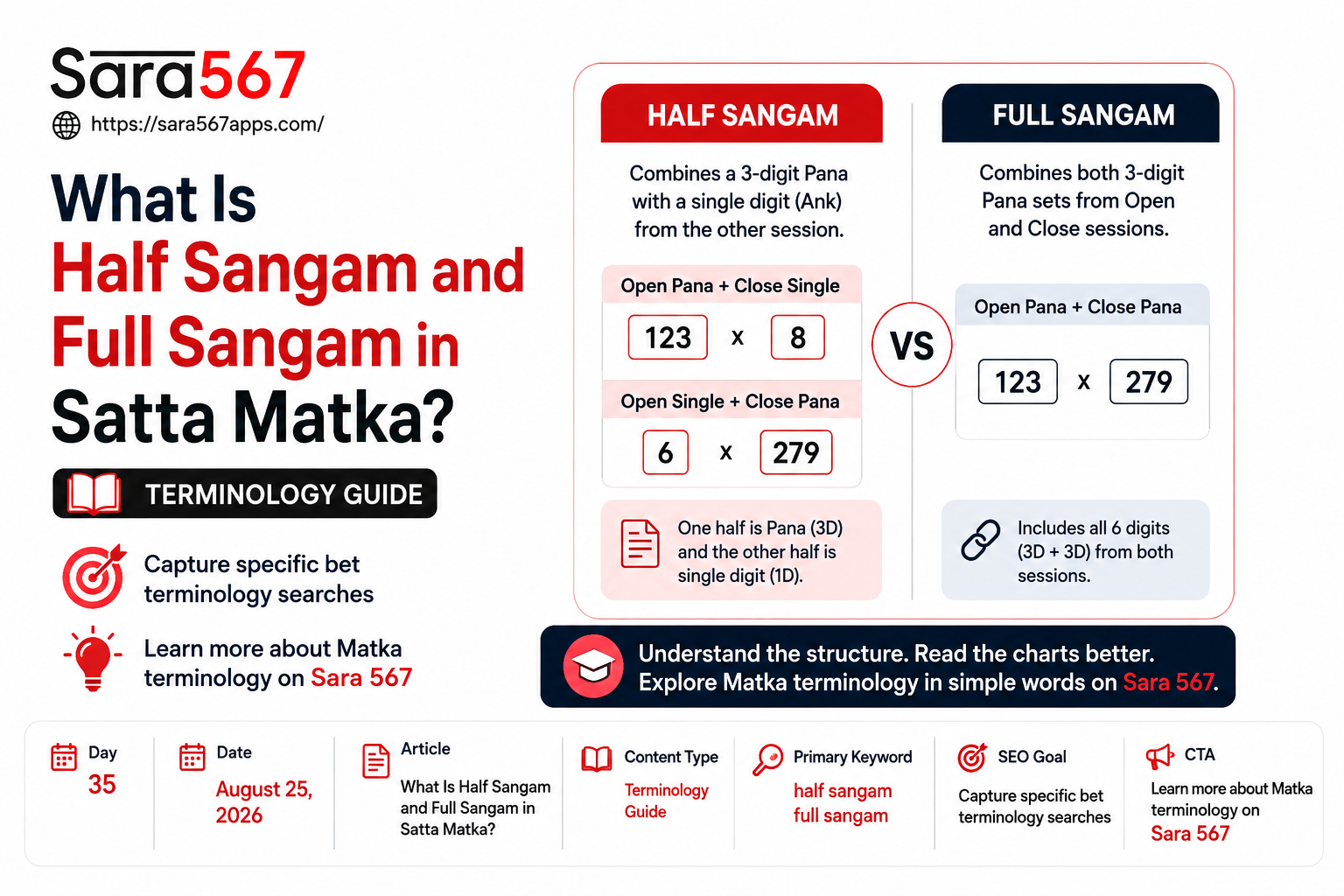
For those who are new to Matka terms, Half Sangam can be described as an hybrid structural format in which one half of the format is based on a 3-digit Pana and the remaining half uses a single number (Ank).
For standard chart layouts it is possible to create a Half Sangam entry pairs one full three-digit set with an individual single digit that is in the other session.
Primary Structural Formats of Half Sangam
Since traditional recording systems have two sessions: an Open session as well as the Close session Half Sangam generally exists in two different structural forms:
- Open Pana and Close Single: A three-digit Pana that was part of the Open session is combined with the single digit of the session that is closed.
- Open Single and Close Pana: Single number from the session Open is joined by the three-digit Pana of the Close session.
Neutral Hypothetical Example
For the purpose of visualizing this structure exclusively in educational contexts:
- Imagine you have an Open session has an Open Single of 123. Pana number of 123 (which is reduced into an Open Single that is 6 ) based on normal sum rules like $1+2+3 = $6).
- If a Close session is the Close Single number of 8 (derived from an Close Pana similar to 279), in which $2+7+9 equals 18 rightarrow $8$).
The Half Sangam reference entry might combine an Open Pana (123) directly with the Close Single (8), which is structurally represented as 1223 x 8. It could also combine an Open Single (6) with the Close Pana (279), which is formatted as 6 279 x 6.

Notice: The numbers in this manual are only hypothetical examples designed to help clarify the meaning of structural terms. These examples do not reflect the predictions, guidelines or real-world results.
What Is Full Sangam?
When Half Sangam combines a three-digit set and a single digit, Full Sangam refers to an entire set of numbers that connect the two 3-digit Pana sets from each session.
In traditional Matka terms, the term Full Sangam represents the most extensive format for documents of reference, as it encompasses each of the six numbers in the Open and Close sessions.
Structural Format of Full Sangam
A Full Sangam format pairs:
- Open Pana (3 digits) + Close Pana (3 digits)
Neutral Hypothetical Example
A simple demonstration of the structure:
- Open Pana set: 123
- Close Pana set: 279
A Full Sangam entry represents the straight structural combination of these two sets that are recorded on the chart of reference as 123 x 279.
As it includes the complete sequence of three digits that was created from the two sessions, Full Sangam represents a completely linked structural entry in the traditional records-keeping archives.
Half Sangam vs Full Sangam
For a quick comparison of how these two words differ in terms of their structure, check out the table below:
| Term | Basic Meaning | General Structure | Beginner Explanation |
|---|---|---|---|
| Half Sangam | Partially combined of Pana and single Digits | (Open Pana x Close Single) OR (Open Single x Close Pana) | An interdisciplinary pairing that connects an i3-digit set from one session to a single-digit set from another session. |
| Full Sangam | A complete combination from two Pana sets | Open Pana x Close Pana | Complete pairing that connects an 0-digit set of the Open session directly to three-digit sets from the Close session. |
Difference Between Half Sangam and Full Sangam
Knowing the difference between Half Sangam and Full Sangam is a matter of being able to count the total digits when entering the data and deciphering the structural components that are connected.
1. Digit Count and Structural Composition
- Half Sangam: It has a total of four active digits within its written form (3 numbers of a Pana + one single number).
- Full Sangam: It has 6 active digits total in its written form (3 numbers from the Open Pana + 3 digits from the Close Pana).
2. Session Symmetry
- Half Sangam is asymmetrical. It couples a sophisticated set (Pana) in one hand and a basic one (Single) one side.
- Full Sangam is Symmetrical. It has with identical structural structures (a 3-digit Pana for each side).
3. Usage in Reference Literature
In discussions of educational content and glossary guidebooks, students frequently confuse both due to the fact that both of them contain the term "Sangam." It is important to remember the fact that "Half" signifies a split format (Pana + Single) in contrast "Full" signifies a dual format (Pana + Pana) can help avoid confusion while studying traditional logs of data.
How Half Sangam and Full Sangam May Appear in Charts
For historical archives as well as documents for education, Matka numbers are typically displayed in grid-like systems. Knowing how they relate to the layout of charts simplifies scanning of reference materials.
TYPICAL HISTORICAL CHART GRID
| Open Session (3D) | Center Jodi Result (2D) | Close Session (3D) |
|---|---|---|
| Open Pana123 | Open Single + Close Single[68] | Close Pana[279] |
In the literature on reference, it is discussed Sangam language with respect to this grid:
- Half Sangam Note: Combining the upper left column (123) along with the right-hand side of the central column (8) which is written as the number 123x8; or the left portion of the middle column (6) and the other right column (279) which is written as 6 279 x 6.
- Full Sangam Notation: Link directly the left column (123) to the inner right column (279) in the form of 123 279.
People who want to learn more about Matka concepts in Sara 567 may make use of this structure breakdown to aid in looking at historical charts as well as entries formats.
Common Beginner Mistakes
While studying Matka terminology, novices typically encounter some frequently-repeated confusions

- The confusion between Half Sangam and Full Sangam: assuming the two words mean the same thing. Half Sangam only requires one digit on each side, while Full Sangam has three digits on both sides.
- Confusion of the term Jodi with a Half Sangam: The Half Sangam Jodi is just a 2-digit combination (68). The term Half Sangam involves a three-digit Pana that is paired with one zero (123 8).
- Incorrectly interpreting the Chart Position: Unable to determine the difference between a single number belonging to the open session or Close session while identifying an Half Sangam structure.
- Studying historical Records as predictive tools: Based on the notion that because the particular Sangam structure was found in the historical archives, it contains the potential to predict future entries. The tables in the historical archives are used as logs of data from past events.
- Making Hypothetical examples as real Recommendations: Don't mistake illustrative instances in guides to education for real advice or recommendations.
Quick Reference Guide to Sangam Terminology
Utilize this table of quick reference to go over the most important definitions in Matka's glossary. Matka glossary:
| Term | What It Refers To | Beginner-Friendly Explanation |
|---|---|---|
| Sangam | The term "general" refers to a combined entry | Any structure format which links elements of an Open session with Close session elements. |
| Half Sangam | A total entry of four digits | A format that combines a three-digit Pana of one session and an 1-digit Single in the other session. |
| Full Sangam | A total entry of 6 digits | A type of layout that pairs a three-digit Open Pana directly with a 3-digit Close Pana. |
| Pana (Patti) | Three-digit numbers in a set | Three-digit block ($000\text$999) that is the base of Sangam entries. |
| Single (Ank) | One-digit number that is a standalone | One number ($0\text9$ - 0) that is derived from or placed together with Pana sets. |
Why Understanding Matka Terminology Matters
Understanding the exact meanings of phrases like half sangam and full sangam can be beneficial to those who are studying the structure of historical charts or reading archives of informational content as well as engaging in discussion about education.
- Enhances clear literacy: Removes confusion when you encounter technical terms from different sources of reference and writing.
- Aids in Distinguishing Layout: Lets users quickly distinguish between basic format (Single, Jodi) and complicated combined format (Half Sangam, Full Sangam).
- Supports objective analysis: Seeing these terms solely as structure-based classifications stops readers from assigning mysterious or predictive characteristics to basic numeral groupings.
Also read: https://sara567apps.com/blog/time-bazar-explained
A clear understanding of terminology will help you use reference material without a doubt, with clarity and a clear understanding.
Conclusion
Knowing the distinction between Half Sangam as well as Full Sangam mainly comes in recognizing their fundamental structure. Half Sangam combines a three-digit Pana that has a single number and Full Sangam connects a three-digit Open Pana with a three-digit Close Pana.
For those who are new to the field, understanding these terms can make conventional charts and terms much more easy to grasp. This guide's examples provide a basic understanding of how to structure, and should not be taken as predictions or advice. Historical charts record previous entries that should be considered only as educational materials.
Frequently Asked Questions
1. What is Half Sangam in Satta Matka?
Half Sangam refers to a structural term used in Matka language that relates to an arrangement that combines a 3-digit Pana of an earlier session (Open or Close) and a single number from the other session.
2. What is Full Sangam in Satta Matka?
Full Sangam refers to a comprehensive structure that combines with a 3-digit Open Pana set directly with an identical three-digit Close Pana set, creating an entry with six digits that is a reference.
3. What's the distinction in Half Sangam and Full Sangam?
The most significant difference is in the structure of the digits Half Sangam pairs a 3-digit Pana with a single digit of 1 (4 total written numbers) in contrast, Full Sangam pairs a 3-digit Open Pana with a 3-digit Close Pana (6 total written numbers).
4. Is Half Sangam and Full Sangam exactly the same?
There is no difference between the two concepts. Half Sangam is a partial or hybrid of Pana and Single digits in contrast, Full Sangam represents a dual mixture made up of 2 Pana sets.
5. Are past Matka charts used to predict future outcomes?
No. The historical Matka charts are archives of previous entries. They are purely documents of the past and do not have any ability to mathematically or logically forecast future events.
Educational Disclaimer
This publication is solely to serve as a reference for historical, educational, and for terminology reference. It is a definition of structural terms as well as the digit format used in conventional tables of references. It does not offer gambling strategies, financial advice and winning forecasts, nor do they provide advice on how to engage in gambling with real money.
SEO Title: Patti Pana Meaning: Single, Double, an…
SEO Title: Patti Pana Meaning: Single, Double, and Triple Pana Explained
Meta Description: Find out the definition of Patti Pana in the Matka. Discover the fundamental differences among Single Pana, Double Pana and Triple Pana with this basic guide.
URL Slug: patti-pana-single-double-triple-pana
Excerpt: Learn what Patti or Pana means in Satta Matka, including the basic difference between Single, Double, and Triple Pana, explained in simple language for beginners
What Is Patti or Pana? Understanding Single, Double, and Triple Pana

Reading through the archives of historical data and reference charts or glossary guides can expose novices to the specialized language. Some of the terms most commonly used in academic Matka materials can be Patti or Pana. If you're encountering these terms in the first place, it can be confusing, especially when they are paired with sub-classifications from different sources.
Understanding the relationship between Patti/Pana entries and their main subcategories--Single Pana, Double Pana, and Triple Pana--is simply a matter of recognizing digit counts and numerical patterns. This guide explains the fundamental meanings, features as well as the layout guidelines of these three-digit formats in order for beginners to read the charts in a way that is clear and easy to understand.
What Is Patti or Pana?
Traditional Matka terms, Patti and Pana are the exact same idea: Three-digit numbers that vary from 999 to 000. In the context of the area and the historical archive or publication of charts the one may be chosen over another. However, conceptually both are synonymous.
In contrast to a single format with digits (one numeral) or the Jodi format (a combination of two numbers) Patti or Pana is a Patti also known as Pana is specified by its 3-digit layout
- Three-Digit Rule: The Pana always has only three digits.
- Ascending Order Convention: In normal chart-keeping, digits within the Pana tend to be listed in ascending sequence (e.g., 123 instead of 321 or 213).
- Grid Placement: Pana entries show as the three-digit blocks that mark those who are in the Open Close and Open Close sessions in the historical sheet of data.
Understanding Single Pana (SP)
The term "Single Pana" is used to describe a single Pana (commonly known to SP) is a 3-digit sequence in which each of the three numbers are distinct and not repeated.
Key Characteristics:
- Digit Composition: Three distinct numerics.
- Numerical Structure: The digits are only visible once within the block.
- Ascending Layout: The layout is written in ascending order from the left side to the right.
Structural Examples:
- 123: Unique digits ( 1, 2, 3) placed in ascending order.
- 248: A Single Pana format featuring distinct numerals (2, 4, 8).
- 357: The 357 is a distinct set of digits that are not repeated ( 3, 5,, 7).
Understanding Double Pana (DP)
The term "double pana" (abbreviated as DP) refers to Double Pana (abbreviated by the abbreviation D.P.) is the three-digit number sequence in which two of the digits are alike and the third one is distinct.
Key Characteristics:
- Digit Composition: Two identical numbers and a unique number.
- Numerical Structure: This structure has one repetition, which is accompanied by an unrelated third three-digit number.
- Standard Display: In ascending order. Keep the numbers that are repeated adjacent to each other when applicable.
Structural Examples:
- 112: It is a repeating couple ( 1, 1) with one distinct single zero (2).
- 336: Includes a doubled 336 digit ( 3, 3) that is paired by (6).
- 778: This is an example of a Double Pana structure that has the twin 7s as well as 8 in eight.
Understanding Triple Pana (TP)
The Triple Pana (abbreviated by the abbreviation the acronym TP) is an acronym for three numbers in which the three numbers are the same.
Key Characteristics:
- Digit Composition: Three matching digits.
- Numerical Structure One numeral that is repeated over the three locations.
- Limitations on Combinations: Since there are just 10 single digits (0 from 9) that means there are 10 possibilities of Triple Pana combinations in standard referential systems (000, the numbers 111, 222 444, 555 666, 7777, 888 and 999).
Structural Examples:
- 111: A Triple Pana comprising three 1.s.
- 555: The Triple Pana comprised three fives.
- 7777: A Triple Pana made up of three sevens.
Single Pana vs. Double Pana vs. Triple Pana
For a quick comparison of how the three formats differ, read the following breakdown:
| Pana Type | Basic Structure | Educational Example | Beginner Explanation |
|---|---|---|---|
| Single Pana (SP) | Three distinct digits | 123 | Three numbers, with no repeating number of digits. |
| Double Pana (DP) | Two digits that match + one unique number | 112 | Three numbers containing a pair of duplicates. |
| Triple Pana (TP) | Three matching digits | 111 | A set of three digits where each number is the same. |
What Is the Difference Between Patti and Pana?
Most often, the reason for confusion among beginners is to determine if Patti and Pana represent different numerical patterns or rules. There aren't any differences in the structure of these two phrases.

- Interchangeable Usage: Both words refer to exactly the same format of 3-digits (000 to 99999).
- Regional Preferences: "Patti" is more prevalent in regional offline dialects as well as documents from the past in contrast "Pana" is more often found in digital glossary guides for modern times.
- Chart Variations: Different sources may favour certain terms over others; however, standard glossaries consider these terms as equivalent synonyms.
How Pana Formats Appear in Historical Charts
In archives for educational purposes, Pana numbers are organized into well-organized columns. A typical entry for a day typically shows the following: an OPEN SESSION Pana as well as the closed session Pana along with a central, 2-digit Jodi.
| Open Pana (3D) | Center Jodi (2D) | Close Pana (3D) |
|---|---|---|
| 123 (Single Pana) | 56 (Jodi Pair) | 112 (Double Pana) |
- Left Column (123): Represents a single Pana (all numbers are distinctive).
- The Center Column (56): Represents a Jodi (a two-digit number combination).
- Right Column (112): Represents an Pana that is a Double Pana (contains a repeating 1-digit couple).
Common Beginner Misconceptions
While learning the vocabulary, novices often get confused about fundamental layout principles. Eliminating these common misconceptions aids in maintaining the accuracy of your analysis:
- Confusion of Pana to Jodi: A Jodi is a strictly 2-digit number (e.g., 45) while Pana/Patti is always a three-digit block (e.g., 123).
- Mistaking Double Pana for Single Pana: A Single Pana requires 3 distinct numbers (248). If more than two digits are repeated (228) this is categorized as an Double Pana.
- Assuming Digit Order is Random Digits in charts Pana records are typically ordered in ascending numerical order.
- The mistake of mistaking 3-digit numbers as Triple Pana: Triple Pana needs the three numbers to match (555). An amount like 556 is considered to be a Double Pana and not a Triple Pana.
- Learning Examples to be viewed as predictions: The examples of numerics in the educational guides are intended to illustrate formatting and not to give predictions or provide advice.
- Insisting that Past Numbers Can Predict Future Performance: Historical charts are historical records of the past. They do not forecast mathematically future outcomes.
Quick Reference Summary
| Term | Digits | Basic Structure | Simple Explanation |
|---|---|---|---|
| Patti / Pana | 3 | 000 to 999 | Every three-digit block found within chart records. |
| Single Pana (SP) | 3 | Three distinct digits | A Pana that does not have repeated numbers (e.g., 357). |
| Double Pana (DP) | 3 | Two repeated digits | A Pana that has one digit (e.g., 336). |
| Triple Pana (TP) | 3 | Three matching digits | A Pana with three digits that are the same (e.g., 777). |
Why Understanding Pana Terminology Matters
Knowing the meanings of structural elements behind Patti and Pana forms provides clear advantages when analyzing source material:
- Improves the literacy of glossaries: It helps users comprehend the technical details across documents without the confusion of digit numbers.
- Improves Chart Layouts It allows users to easily discern whether a chart utilizes a single, double or Triple Pana arrangement.
- Supports objective Analysis: Labels these phrases as categorical categories for structural purposes, allowing readers to examine chart entries with an objective view, like numerical logs from the past.
Also read: https://sara567apps.com/blog/main-bazar-matka-explained
Conclusion
In simple terms, Patti or Pana is a common term used in Satta Matka terminology. Single, Double, and Triple Pana are different ways the term is generally described. Understanding these basic terms can make Matka-related charts and discussions easier to follow. This guide is shared for educational and reference purposes only.
Frequently Asked Questions
1. What is Patti or Pana?
Patti or Pana refers to a 3-digit numerical combination (ranging from 999 to 000) utilized in charts. Both are synonyms that can be used interchangeably.
2. What is a Single Pana?
A Pana is a single Pana is a 3-digit sequence consisting of three distinct, non-repeating numbers (e.g., 123 or 248), generally placed in ascending order of numerical value.
3. What is a Double Pana?
The term "double pana" refers to Double Pana is a three-digit combination of two numbers that are identical and an individual numeral (e.g., 112 or 336).
4. What is a Triple Pana?
A Triple Pana is a combination of three digits in which all three numbers are exactly the same (e.g., 111, 555, or 777).
5. What are the major distinctions between Double, Single and Triple Pana?
The most significant difference is repeated digits. Single Pana is a single digit that has no repeating digits. Double Pana contains two similar numerals, while Triple Pana contains three matching three digits.
Educational Disclaimer
The publication is intended to be used for educational, historical and for terminology reference. The publication describes the numerical structure and formatting standards used in old chart references. This information does not offer any betting strategies, financial information or forecasts for betting on sports.