Matka Mathematics: Calculating Potential Winnings
Matka Mathematics: Calculating Potential Winnings
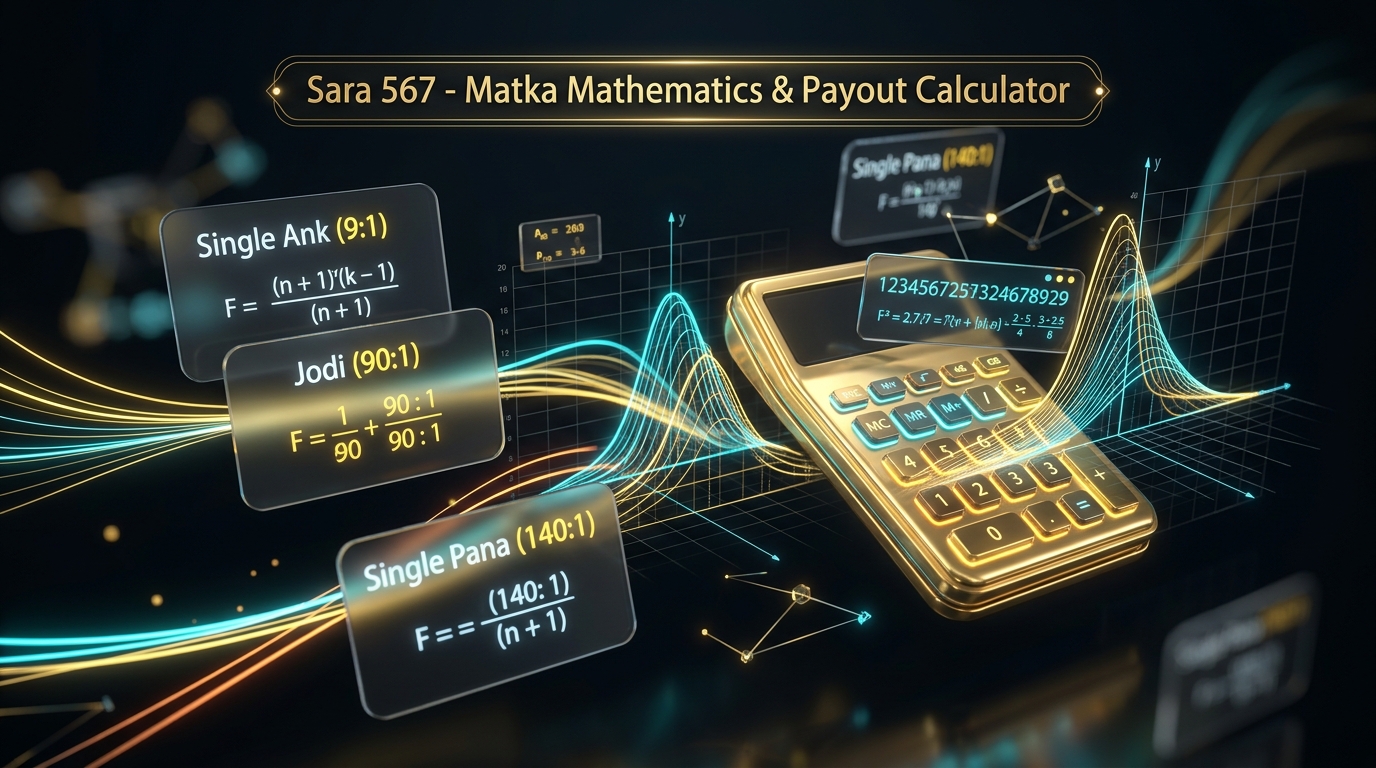
Behind the colorful slang, historic terminology, and bustling market schedules of Satta Matka lies a foundation of pure probability and arithmetic. While novice participants often rely on intuition or unverified rumors, experienced analysts know that mastering matka mathematics winnings is the single most important prerequisite for responsible and structured participation.
Understanding how to calculate matka payout multipliers, dissecting single jodi patti math, and mastering betting odds calculation formulas allows enthusiasts to evaluate risk against reward objectively. By stripping away emotion and examining the cold numbers, players can make informed decisions while protecting their bankroll from irrational exposure.
Following our foundational breakdowns on Odds & Probability Fundamentals, Common Beginner Mistakes, and Responsible Gambling Practices, this comprehensive guide provides an exhaustive mathematical blueprint for every major Matka market on Sara 567.
1. The Core Equation: How Payouts Are Calculated
In Satta Matka, calculating potential returns is governed by a straightforward linear formula:
$\text{Gross Payout} = \text{Stake Amount} \times \text{Payout Multiplier}$
$\text{Net Profit} = \text{Gross Payout} - \text{Stake Amount}$
Historically, street bookmakers expressed payouts using colloquial phrases such as "10 ka 90" or "10 ka 1400", which simply translates to a multiplier ratio:
- "10 ka 90" = Payout multiplier of 9x (or 90 for every ₹10 staked).
- "10 ka 900" = Payout multiplier of 90x (or 900 for every ₹10 staked).
- "10 ka 1400" = Payout multiplier of 140x (or 1,400 for every ₹10 staked).
Modern online platforms like Sara 567 standardize these numbers into transparent digital decimals, allowing users to verify their potential returns instantly before confirming any selection.
2. Format-by-Format Mathematical Breakdown
Every wager category in Matka features a distinct probability curve, mathematical pool size, and corresponding payout ratio. Here is the exact arithmetic for each format:
A. Single Ank (Single Digit: 0 to 9)
- Total Possible Outcomes: 10 digits (
0, 1, 2, 3, 4, 5, 6, 7, 8, 9). - Mathematical Probability: $1 \div 10 = 0.10$ (10.0%).
- Standard Payout Multiplier: 9x to 9.5x.
- Calculation Example:
- Stake: ₹100 on Single Ank
4. - Gross Payout: ₹$100 \times 9.5 = \text{₹}950$.
- Net Profit: ₹$950 - \text{₹}100 = \text{₹}850$.
- Stake: ₹100 on Single Ank
B. Jodi (Two-Digit Combination: 00 to 99)
- Total Possible Outcomes: 100 pairs (
00to99). - Mathematical Probability: $1 \div 100 = 0.01$ (1.0%).
- Standard Payout Multiplier: 90x to 95x.
- Calculation Example:
- Stake: ₹100 on Jodi
45. - Gross Payout: ₹$100 \times 90 = \text{₹}9,000$.
- Net Profit: ₹$9,000 - \text{₹}100 = \text{₹}8,900$.
- Stake: ₹100 on Jodi
C. Single Pana / Patti (Three Ascending Unique Digits)
- Total Possible Outcomes: 120 unique 3-digit combinations out of 220 total Panas (~54.5%).
- Mathematical Probability: $1 \div 220 \approx 0.00454$ (0.454% per specific Pana).
- Standard Payout Multiplier: 140x to 150x.
- Calculation Example:
- Stake: ₹50 on Single Pana
137. - Gross Payout: ₹$50 \times 150 = \text{₹}7,500$.
- Net Profit: ₹$7,500 - \text{₹}50 = \text{₹}7,450$.
- Stake: ₹50 on Single Pana
D. Double Pana / Patti (Two Identical Digits + One Unique Digit)
- Total Possible Outcomes: 90 combinations out of 220 (~40.9%).
- Mathematical Probability: $1 \div 220 \approx 0.00454$ (0.454% per specific Pana).
- Standard Payout Multiplier: 280x to 300x.
- Calculation Example:
- Stake: ₹50 on Double Pana
112. - Gross Payout: ₹$50 \times 300 = \text{₹}15,000$.
- Net Profit: ₹$15,000 - \text{₹}50 = \text{₹}14,950$.
- Stake: ₹50 on Double Pana
E. Triple Pana / Patti (Three Identical Digits: 000 to 999)
- Total Possible Outcomes: 10 combinations (
000, 111, 222, 333, 444, 555, 666, 777, 888, 999). - Mathematical Probability: $1 \div 220 \approx 0.00454$ (0.454% per specific Triple Pana).
- Standard Payout Multiplier: 700x to 1,000x.
- Calculation Example:
- Stake: ₹20 on Triple Pana
777. - Gross Payout: ₹$20 \times 800 = \text{₹}16,000$.
- Net Profit: ₹$16,000 - \text{₹}20 = \text{₹}15,980$.
- Stake: ₹20 on Triple Pana
F. Half Sangam and Full Sangam
- Half Sangam (1 Open Pana + 1 Close Ank OR 1 Open Ank + 1 Close Pana):
- Total Possibilities: $220 \times 10 = 2,200$ combinations.
- Standard Payout Multiplier: 1,000x to 1,400x.
- Full Sangam (1 Open Pana + 1 Close Pana):
- Total Possibilities: $220 \times 220 = 48,400$ combinations (simplified) up to $1,000,000$ theoretically across card draws.
- Standard Payout Multiplier: 10,000x to 15,000x.
3. Master Payout & Mathematical Comparison Matrix
The following table contrasts the true mathematical probability against standard industry payout multipliers:
| Wager Format | Total Possible Choices | True Probability (%) | Standard Payout Ratio | Typical Net Profit on ₹100 Stake | Risk / Volatility Level |
|---|---|---|---|---|---|
| Single Ank | 10 | 10.00% | 9.5 : 1 | ₹850 | Low (Best for Beginners) |
| Jodi | 100 | 1.00% | 90 : 1 | ₹8,900 | Moderate |
| Single Pana (SP) | 220 (120 SPs) | 0.45% | 150 : 1 | ₹14,900 | High |
| Double Pana (DP) | 220 (90 DPs) | 0.45% | 300 : 1 | ₹29,900 | Very High |
| Triple Pana (TP) | 220 (10 TPs) | 0.45% | 800 : 1 | ₹79,900 | Extreme |
| Half Sangam | 2,200 | 0.045% | 1,200 : 1 | ₹1,19,900 | Extreme (Lottery-Style) |
| Full Sangam | 48,400+ | 0.002% | 12,000 : 1 | ₹11,99,900 | Maximum Variance |
4. Expected Value (EV) & The Built-in Operator Edge
In mathematical game theory, Expected Value (EV) measures the average amount a player can expect to win or lose per wager over thousands of iterations:
$EV = (P_{\text{win}} \times \text{Net Profit}) - (P_{\text{loss}} \times \text{Stake})$
Let us calculate the Expected Value for a standard Single Ank wager at 9.0x payout:
- $P_{\text{win}} = 0.10$, $\text{Net Profit} = \text{₹}800$ (on ₹100 stake).
- $P_{\text{loss}} = 0.90$, $\text{Loss} = \text{₹}100$.
- $EV = (0.10 \times 800) - (0.90 \times 100) = 80 - 90 = -\text{₹}10$.
This calculation proves that for every ₹100 staked, the mathematical house edge is 10% (an expected long-term return to player of 90%).
Similarly, for a Jodi paying 90x:
- $EV = (0.01 \times 8,900) - (0.99 \times 100) = 89 - 99 = -\text{₹}10$ (10% House Edge).
Why the House Edge Matters
Because the mathematical expectation is consistently negative across every bet type, no progressive staking system (such as the Martingale strategy of doubling stakes after every loss) can overcome the house edge. Over a large enough sample, geometric escalation will inevitably encounter a losing streak that wipes out the entire bankroll.
5. Smart Bankroll Arithmetic: The Unit Allocation Rule
To participate sustainably as a recreational hobby, mathematical risk management is mandatory:
┌────────────────────────────────────────────────────────────────────────┐
│                   THE 1% UNIT BANKROLL ALLOCATION MODEL                │
├────────────────────────────────────────────────────────────────────────┤
│ Total Monthly Discretionary Entertainment Budget:  ₹5,000              │
│ Standard Unit Size (1% of Total Pool):             ₹50                 │
│ Maximum Single-Session Cap (2 Units):              ₹100                │
│ Maximum Daily Loss Stop Line (4 Units):            ₹200                │
└────────────────────────────────────────────────────────────────────────┘
- Fixed Flat Staking: Never scale your wager based on frustration or a feeling that a number is "due."
- Never Reinvest Winnings Instantly: When a winning session occurs, withdraw the profit immediately and continue wagering only with the predetermined unit size.
- Decouple Daily Life from the Ledger: Always maintain an objective personal spreadsheet logging stakes, returns, and net balances.
6. How Sara 567 Empowers Data-Driven Analysts
Sara 567 is built as an analytical and informational portal designed to bring transparency and education to the gaming community:
- Unbiased Math & Rules: Clear guides like How to Play Satta Matka teach you the exact arithmetic and probability breakdowns before you engage.
- Unaltered Historical Ledgers: Neutral, verified Jodi Charts and Panel Charts allow players to verify historical frequency distributions without manipulation.
- Zero-Latency Live Verification: Real-time declarations across Kalyan, Milan, and Rajdhani ensure outcomes are recorded with complete precision.
7. Responsible Gaming Notice (Strictly 18+)
Number market analysis should always be enjoyed as an intellectual and recreational exercise:
- Mathematical Inevitability: Remember that the house edge exists on every format. Do not treat Matka as an investment strategy or guaranteed income source.
- Strict 18+ Underage Prohibition: Market data and participation are strictly restricted to adults aged 18 years and above.
- Set Firm Boundaries: If market tracking begins interfering with your personal life, budget, or family welfare, review our Responsible Gambling Practices, consult our Terms of Service and Disclaimer, or contact support organizations like Gamblers Anonymous (gamblersanonymous.org).
Frequently Asked Questions (FAQ)
How are winnings calculated in Satta Matka?
Potential winnings are calculated by multiplying your stake amount by the specific bet type's payout multiplier (e.g., ₹100 on a 90x Jodi produces a gross payout of ₹9,000 and a net profit of ₹8,900).
What does "10 ka 90" mean in Jodi betting?
"10 ka 90" is traditional street terminology indicating that for every ₹10 staked on a correct Jodi, the player receives ₹900 (a 90x multiplier ratio).
What is the difference between Single Pana and Double Pana payouts?
Single Pana (three unique digits, e.g., 137) typically pays 140x to 150x, while Double Pana (two identical digits, e.g., 112) pays 280x to 300x because Double Panas are less frequent in the total combination pool (90 DPs vs. 120 SPs).
What is the mathematical probability of winning a Single Ank?
There are 10 single digits (0 through 9). Each digit has an exact 1 in 10 (10.0%) probability of appearing on any given draw.
Can the Martingale doubling system beat the Matka house edge?
No. Because each draw is an independent random event with an operator house edge of ~5% to 10%, doubling your wager after each loss will eventually trigger table limits or deplete your entire capital during a normal statistical losing streak.
Where can I verify transparent Matka charts and payout structures?
You can study comprehensive, date-indexed historical Matka Charts and verified live updates for all major Indian markets directly on Sara 567.
Explore Corresponding Market Charts & Verification Tools
Verify real-time numbers, track open/close records, and analyze weekly trends on our informational dashboard.